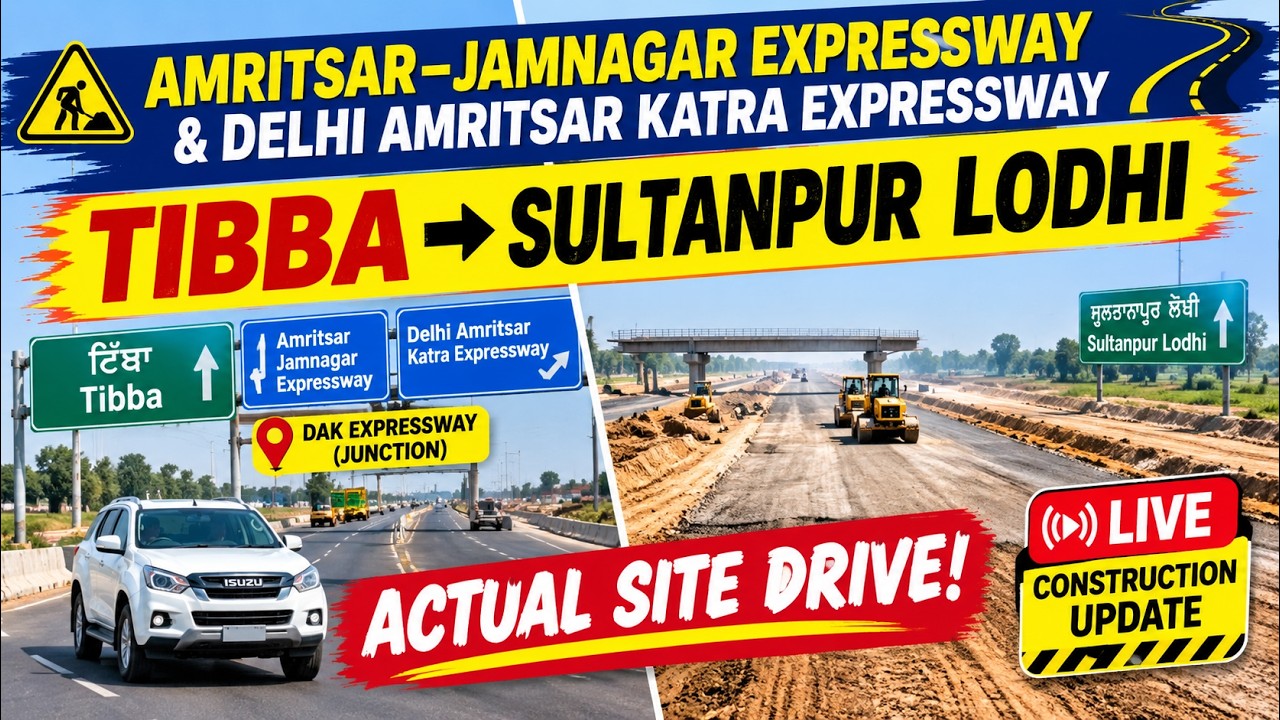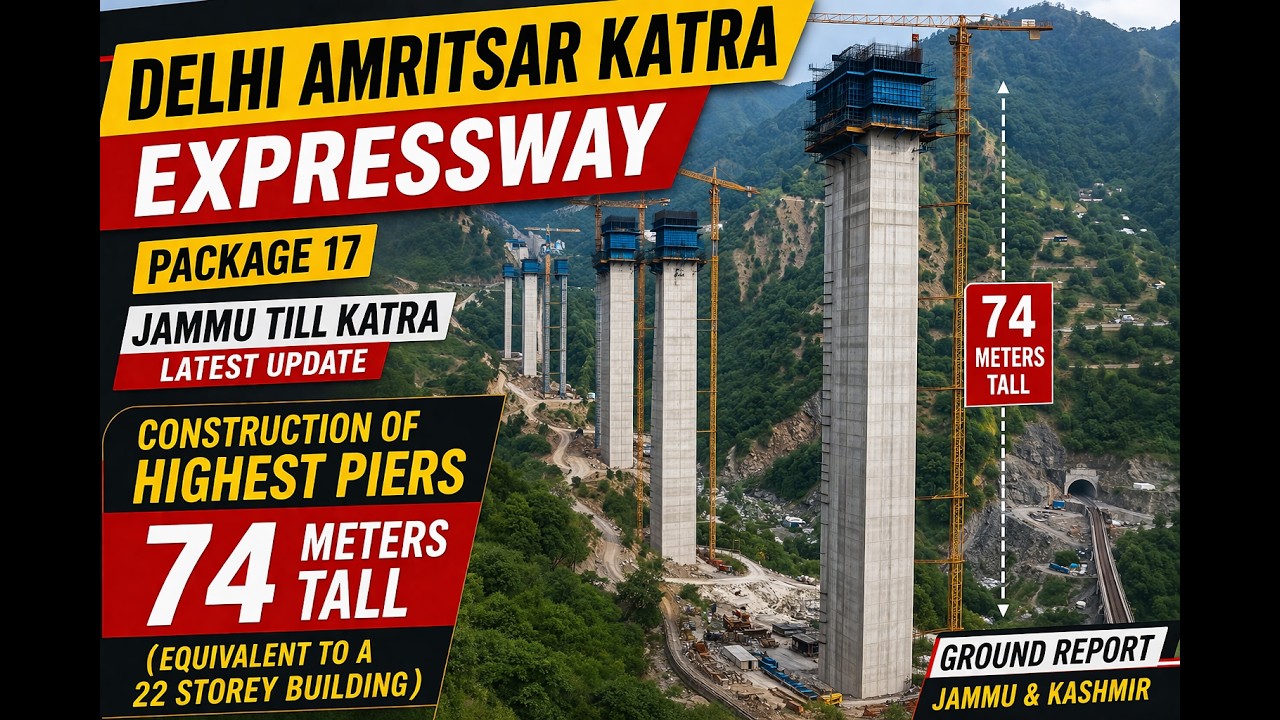

The Ghulatis On The Go team embarked on a journey to document the ongoing construction of the Amritsar–Jamnagar Expressway in Punjab. This particular segment of their exploration focused on the stretch from Sultanpur Lodhi to Kala Singhiān and Lohian Khas Road, offering a firsthand look at the ground reality of this significant infrastructure project. The video provides a detailed update on the progress, highlighting both completed sections and areas still under development, giving viewers a comprehensive understanding of the current state of the expressway.
The journey commenced from Sultanpur Lodhi Road, where the team aimed to cover the construction updates leading up to Lohian Khas. Along the initial part of the route, the road was a narrow, tree-lined path, characteristic of rural areas. The drive revealed green fields on either side, with occasional small buildings and power lines. The team noted that this section was part of the Amritsar Spur of the Delhi–Amritsar–Katra Expressway, which eventually connects to the Jamnagar Expressway near Tibba village. They had previously covered the Tibba stretch in an earlier video, where construction was minimal. This time, they anticipated a similar situation on the Kala Singhiān Road.
Delhi–Amritsar–Katra Expressway: Amritsar Spur
As the team approached the Delhi–Amritsar–Katra Expressway, the construction site became visible in the distance. This section, identified as the Amritsar Spur, branches off from the main expressway near Kang Sabu village in Jalandhar and heads towards Amritsar. It is designed to merge with the Jamnagar Expressway at Tibba village. The team drove under a completed flyover, noting the substantial concrete structures that were already in place. However, the road beneath the flyover was still unpaved, consisting of dirt and gravel, indicating that significant work remained for the connecting routes.
Upon reaching the expressway alignment, the team observed a long retaining wall made of interlocking concrete blocks. While the wall itself appeared complete, the area adjacent to it was an unpaved, dusty track. The team expressed concern that the retaining wall seemed to be leaning inwards in some sections, or perhaps it was part of the design. Despite the presence of the wall, there was no visible construction activity on the expressway itself, suggesting a halt in progress. Overgrown bushes and a lack of construction materials or trucks further supported the observation that this part of the project had been stalled for some time.
Stalled Progress and Local Roads
The drive along the unpaved track next to the expressway revealed a desolate landscape, with no signs of recent work. The team noted that while the area was earmarked for the expressway and proper earth filling had been done, the actual construction had not progressed. The presence of stagnant water and mosquitoes in an underpass further indicated the lack of activity. After driving as far as possible on the rough terrain, the team decided to turn back, concluding that there was no immediate benefit in proceeding further on the incomplete stretch. They reiterated that the main objective was to document the Jamnagar Expressway's construction, and this particular section of the Delhi–Amritsar–Katra Expressway was currently at a standstill.
Returning to the Kala Singhiān Road, the team continued their journey towards Sultanpur Lodhi. They praised the quality of the local village roads in this area, noting their smooth surface and the pleasant green cover on both sides. These well-maintained local roads offered a stark contrast to the unfinished expressway sections. The team expressed their enjoyment of driving through such picturesque routes, highlighting the beauty of the agricultural landscape. They passed through an area marked as Sant Seechewal Ji Ki Nirmal Kutir, a well-maintained and aesthetically pleasing complex, further adding to the charm of the local drive.
Connecting to the Jamnagar Expressway
As they approached the Jalandhar–Sultanpur Road, a sign indicated that Dalla village was 2 km away and Sultanpur was 5 km away. This road was a crucial link to the Jamnagar Expressway. The team planned to access the expressway from this point, noting that the flyover section of the Jamnagar Expressway appeared complete from above. Their strategy was to ascend the expressway from this intersection and then drive backwards towards the point where they had concluded their previous video, near the Sultanpur–Kapurthala Road. This approach would allow them to provide a continuous update on the construction progress.
Upon reaching the Jalandhar–Sultanpur Road, the team confirmed their location using a satellite image, showing their car positioned near a factory, adjacent to the completed section of the expressway. They then proceeded to ascend the expressway, which was fully paved and marked, with crash barriers and streetlights already installed. The smooth ride on this completed section was a welcome change from the rough dirt tracks they had navigated earlier. A large overhead sign indicated distances to Bathinda (123 km), Moga (54 km), and Shahkot (43 km), confirming their presence on a functional part of the Amritsar–Jamnagar Expressway.
Smooth Ride and Ongoing Earthwork
The drive on the completed section of the Jamnagar Expressway was described as exceptionally smooth, with no jerks and well-matched joints, akin to a 'butter highway'. The team noted the presence of speed limit signs, including one for 100 km/h, indicating that this part of the expressway was ready for use. They observed that even central light poles were installed in some areas. This stretch of the expressway, approximately 4 km long, provided a comfortable driving experience, showcasing the high quality of the finished construction.
However, the smooth ride eventually gave way to an unpaved section, marking the end of the completed carriageway. Here, the landscape transformed into a vast expanse of earthwork, with large piles of sand and dirt on both sides of the road. The team noted that the material being used for filling appeared to be a black ash-like substance rather than traditional soil, suggesting a change in construction methods. Despite the rough terrain, the presence of heavy machinery, including excavators and dump trucks, indicated active construction. Workers were seen engaged in earth-filling and leveling activities, suggesting that this section was undergoing rapid development.
Future Outlook and Next Steps
The sight of active construction and significant earthwork on the unpaved sections offered a positive outlook for the future completion of the Amritsar–Jamnagar Expressway. The team observed that the work was progressing at a good pace, with numerous pillars already erected for upcoming flyovers and bridges. While the connecting roads to these structures were still under construction, the overall impression was one of steady progress. The team concluded their video at the Kala Singhiān–Lohian Khas Road, where they noted the ongoing work and the presence of construction vehicles. They plan to continue their coverage from this very spot in their next video, moving further towards Dharamkot and Moga, to provide more updates on the Jamnagar Expressway's construction.
Practical Takeaways
- The Amritsar Spur of the Delhi–Amritsar–Katra Expressway, particularly the section near Kala Singhiān Road, shows stalled construction with unpaved tracks and overgrown vegetation, indicating a lack of recent activity.
- The main carriageway of the Amritsar–Jamnagar Expressway, accessible from the Jalandhar–Sultanpur Road, is largely complete with smooth asphalt, crash barriers, and streetlights, offering a comfortable driving experience for approximately 4 km.
- Beyond the completed section, extensive earthwork is underway, with large piles of black ash-like material being used for filling, suggesting active and rapid construction in these areas.
- Local village roads in the Sultanpur Lodhi area are well-maintained and offer pleasant, tree-lined drives, providing an alternative to the incomplete expressway sections.
- Commuters should be aware of varying road conditions, from smooth completed expressway sections to rough, unpaved construction zones, and plan their routes accordingly.
Watch the Original Journey
This article is connected to the original Ghulatis On The Go video below. Watch it for the complete visual experience and conversations from the road.
Key moments from the video
Continue exploring
Related guides, articles, and videos
These recommendations are matched to this Journey Article using its locations, routes, vehicles, categories, and practical travel topics.
Recommended travel guide
India Highway & Expressway Guides
Helpful notes on expressways, national highways, road conditions, rest breaks, toll planning, and safe long-distance driving.
Open this topic guideRelated reading