
Choosing a vehicle for an Indian family road trip is not as simple as comparing engine power, battery capacity, seating capacity or the number of features listed in a brochure. The right vehicle depends on the family, the luggage, the destination, the road surface, the weather, the available charging or fuel infrastructure and how much uncertainty the driver is prepared to accept.
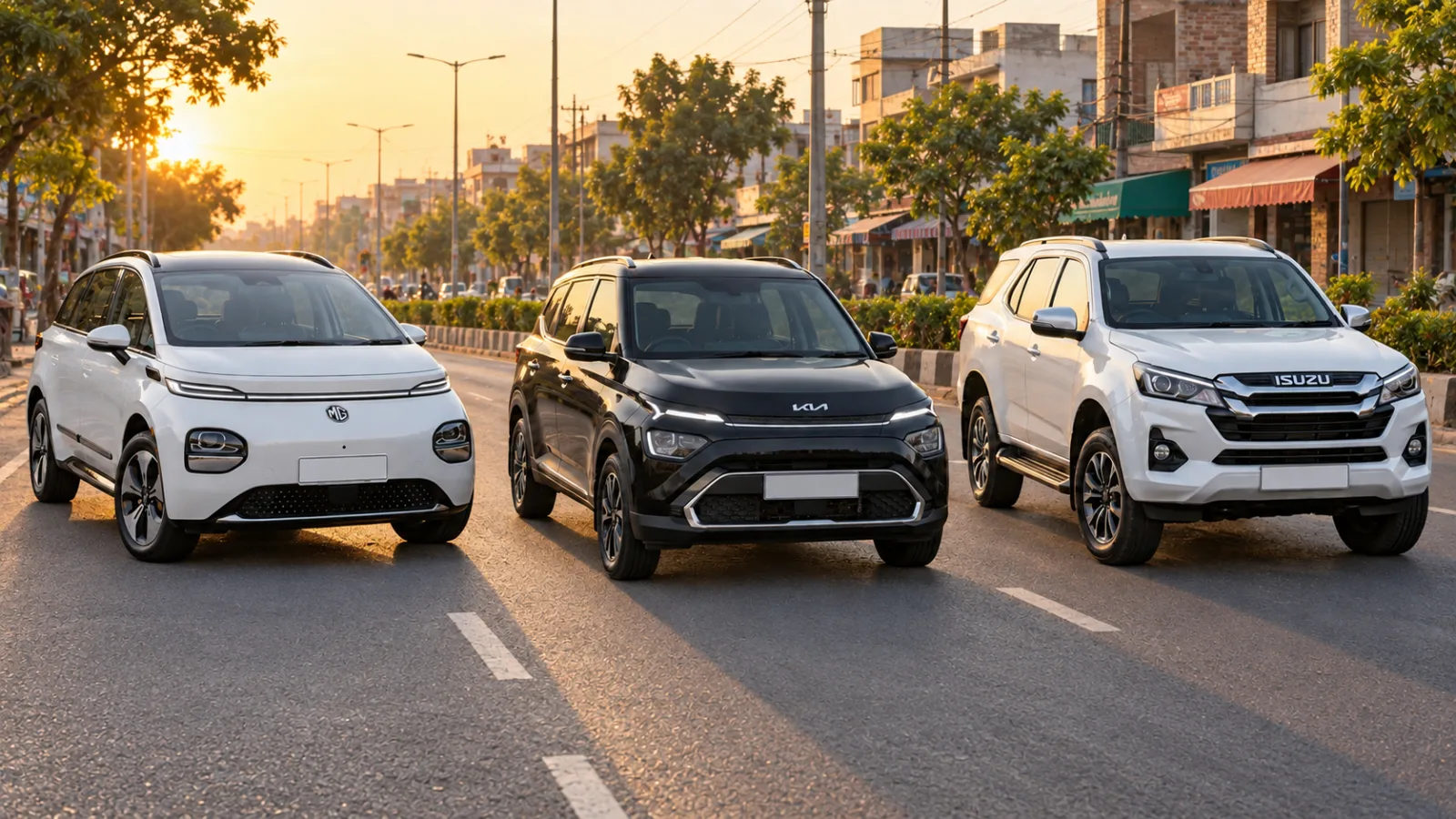
The MG Windsor EV, Kia Carens and Isuzu mu-X 4x2 approach family travel in three very different ways. The Windsor is a quiet and spacious five-seat electric vehicle. The Carens is a flexible family vehicle with three-row seating. The mu-X is a large diesel SUV built around a heavy-duty ladder-frame platform.
None of them can be declared the universal winner because they solve different road-trip problems. The more useful question is:
Which vehicle would we choose for a particular journey, and why?
This comparison focuses on the considerations that matter after the excitement of buying a vehicle has passed: passenger comfort, luggage, driving fatigue, city traffic, expressway journeys, hill roads, charging or refuelling, rough surfaces and the ability to adapt when the original travel plan changes.
Important context before comparing the vehicles
The Ghulatis On The Go Isuzu mu-X is the 4x2 version. This is important because its abilities should not be confused with those of the four-wheel-drive mu-X. The 4x2 still has the size, ground clearance, diesel engine, ladder-frame construction and road presence of a full-size SUV, but it does not have the four-wheel-drive system intended for more demanding off-road conditions.
The exact battery version of the Windsor EV and the exact engine, transmission and seating configuration of the Carens have not been used to make trim-specific claims in this article. Both model ranges have been offered in multiple versions. Owners should check their registration documents, invoice or owner’s manual before relying on a specification that may vary by model year or variant.
- Manufacturer figures are controlled-test figures. Real range and fuel economy change with speed, temperature, traffic, elevation, tyre pressure, passenger load and driving style.
- Features vary between variants. Safety, convenience and driver-assistance equipment should be verified for the exact vehicle.
- Road and charging conditions change. A route that was easy during one journey may require a different plan several months later.
- This is a trip-suitability comparison. It is not a recommendation to drive beyond the safe limits of any vehicle.
The three personalities at a glance
Vehicle Basic character Strongest use case Main planning consideration MG Windsor EV Five-seat electric crossover with a quiet cabin, spacious interior and smooth power delivery City travel, regional family trips and long drives on routes with dependable charging Battery range, charging availability, charging time and backup chargers Kia Carens Family-focused three-row vehicle balancing passenger space, comfort and everyday usability Larger family groups, airport trips, pilgrimages and conventional highway journeys Luggage space when every row is occupied and the performance of the specific engine variant Isuzu mu-X 4x2 Full-size seven-seat diesel SUV with ladder-frame construction and a substantial road presence Very long journeys, difficult approaches, poor roads and trips requiring strength and flexibility Large exterior dimensions, fuel consumption, parking and the limitations of the 4x2 drivetrainMG Windsor EV: quiet, spacious and inexpensive to run when the route supports it
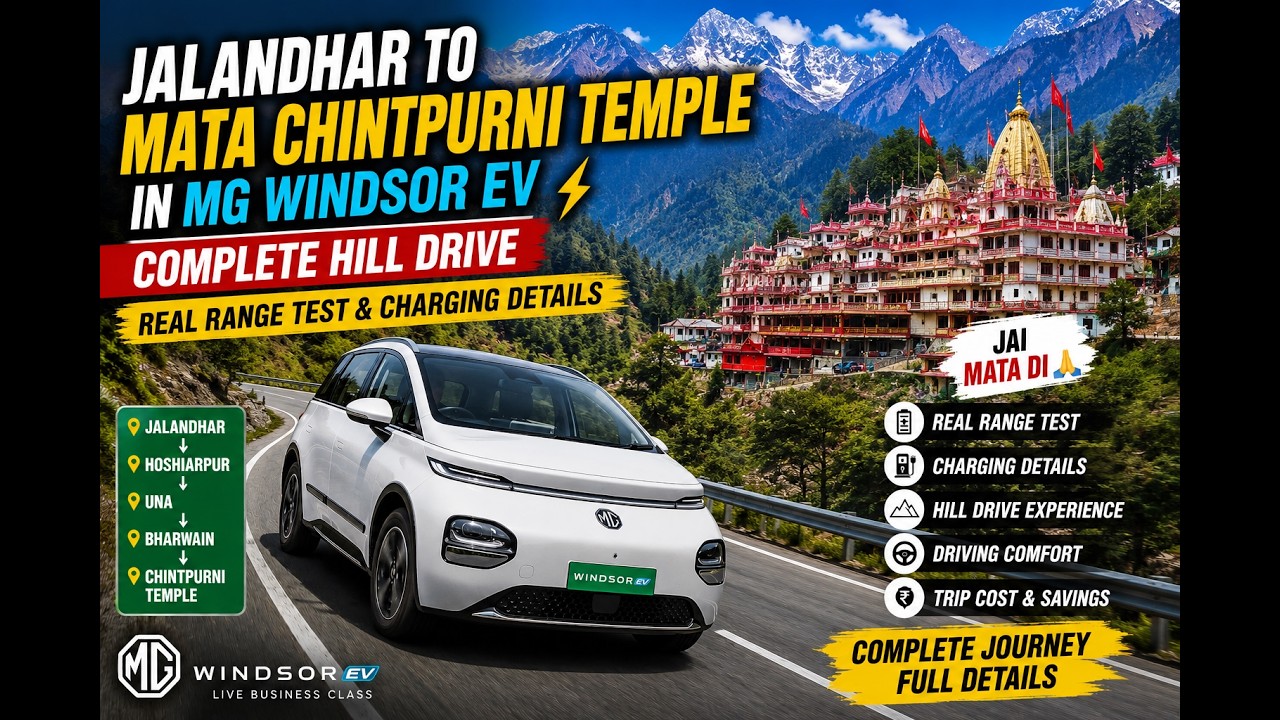
The Windsor EV brings a very different rhythm to a road trip. There are no conventional gear changes and no diesel or petrol engine working in the background. Power delivery is immediate, progress can feel smooth and the cabin remains relatively calm during ordinary driving.
MG currently lists the Windsor as a five-seat electric vehicle with a 2,700 mm wheelbase. Depending on the version, the model range includes 38 kWh and 52.9 kWh battery options. The corresponding certified range figures are approximately 332 km and 449 km. These figures are useful for comparing versions, but they should never be treated as guaranteed highway distances.
Real-world range can be affected by:
- Sustained highway speed
- Air-conditioning or heating use
- Cold or extremely hot weather
- Hill climbs and elevation changes
- Passenger and luggage weight
- Traffic diversions or unplanned local driving
- Tyre pressure and wheel size
- Acceleration, braking and driving style
Where the Windsor feels most natural
The Windsor makes the strongest case when the journey has predictable charging. A family leaving home with a full battery can cover local errands, city visits and many regional day trips without visiting a public charger. This is one of the biggest advantages of an EV: the journey can begin with its energy already loaded at home.
For longer travel, a good Windsor route is one where charging stops can be combined with meals, washroom breaks or sightseeing. A 30- to 50-minute stop feels less like a delay when the family would have stopped anyway.
The Windsor is particularly well suited to:
- Daily travel within Jalandhar and nearby cities
- Day trips that remain comfortably inside the vehicle’s usable range
- Highway corridors with multiple verified fast chargers
- Trips carrying five or fewer passengers
- Journeys where quietness and smoothness are high priorities
- Routes where the family can start with a full home charge
Passenger comfort and luggage
The Windsor’s long wheelbase and flat EV-style packaging help create a cabin that feels spacious for a five-seat vehicle. It avoids the compromise of squeezing a third row into the rear, allowing the second row and luggage compartment to receive more attention.
That makes it useful for a family of four or five carrying normal holiday luggage. It can also be an excellent airport vehicle when the passenger count leaves enough room for suitcases.
The limitation is equally clear: it is not the answer when six or seven people need to travel in one vehicle. At that point, the Carens or mu-X becomes the more practical starting point.
The Windsor on long expressway journeys
An EV can be relaxing on a smooth expressway because of its quiet cabin and immediate response. However, high cruising speeds can increase energy consumption. Saving a few minutes by driving faster may create a longer charging stop later.
A sensible EV driver watches more than the distance-to-empty display. The plan should consider:
- Distance to the primary charger
- Distance to a backup charger
- Expected battery percentage on arrival
- Charger speed and connector compatibility
- Recent user reports about charger reliability
- Food, washrooms, lighting and safety at the location
- Whether the charger is accessible outside business hours
The Windsor can complete serious long-distance journeys, but the driver should treat charging as part of the itinerary rather than something to solve after the battery becomes low.
Windsor weaknesses to understand
- Charging creates dependency. A charger can be occupied, blocked, offline or slower than expected.
- It is limited to five seats. Larger family groups need another solution.
- High-speed efficiency matters. Driving style can noticeably alter the next charging stop.
- Remote travel requires more preparation. A petrol pump can be easier to find than a dependable fast charger.
- Repair and recovery planning is different. EV-specific assistance may not be available everywhere.
Kia Carens: the balanced family all-rounder
The Kia Carens occupies the middle ground in this comparison. It is easier to manage than a full-size SUV but can carry more people than the five-seat Windsor. Its greatest strength is not one dramatic specification. It is the number of normal family situations it can handle without requiring an unusual plan.
Kia lists the Carens with six- and seven-seat configurations depending on the variant. It has a 2,780 mm wheelbase, flexible second- and third-row seating and air-conditioning provision for rear passengers. The model range includes different petrol and diesel engines and several transmissions, so performance and fuel economy must be discussed in relation to the exact vehicle.
Why the Carens works for family travel
Family trips are often decided by access, seating and small conveniences rather than horsepower. Passengers need space to enter and exit, places to keep water and phones, charging points, usable air-conditioning and seats that do not become tiring after two hours.
The Carens has been designed around those everyday needs. Depending on configuration, it offers flexible second-row seating, a foldable third row and roof-mounted air vents serving the rear portion of the cabin.
It is particularly useful for:
- Trips carrying more than five people
- Family pilgrimages and multigenerational travel
- Airport transfers where passenger capacity matters
- Highway trips without charging-stop planning
- Journeys combining city roads and national highways
- Families that want one vehicle for daily use and holidays
The third-row and luggage compromise
A three-row vehicle gives a family flexibility, but it does not create unlimited space. When the third row is occupied, the luggage area becomes more restricted. This is important for airport journeys, weddings and long holidays where every passenger may carry a large bag.
Before choosing the Carens for seven people, the family should physically test the planned luggage. Do not assume that the bags will fit because the seats do.
Possible solutions include:
- Using smaller soft-sided bags instead of rigid suitcases
- Keeping frequently needed items in one small cabin bag
- Folding part of the split third row when carrying six passengers
- Reducing duplicate items between family members
- Avoiding loose luggage that can move during sudden braking
Carens comfort on a long journey
The Carens can be an excellent long-distance family vehicle because passengers are not forced into one fixed seating arrangement. The second row can be adjusted and the third row can be folded when it is not needed.
However, comfort should be evaluated row by row. A seat that feels acceptable during a 20-minute test drive may feel very different after four hours. Adult passengers using the third row should be given regular opportunities to stretch.
The exact engine matters as well. A fully loaded seven-seat vehicle will place greater demand on the powertrain during overtaking and hill climbs. Drivers should leave larger safety margins and avoid assuming the vehicle will respond in the same way as it does with only one or two occupants.
Carens weaknesses to understand
- Full occupancy reduces luggage flexibility.
- The third row may not be equally comfortable for every adult.
- Ground clearance does not make it a rugged off-road vehicle.
- Performance differs by engine and transmission. Advice for one version may not apply to another.
- A heavily loaded vehicle needs patient driving. Braking and overtaking distances should be adjusted.
Isuzu mu-X 4x2: strength, space and confidence on demanding journeys
The Isuzu mu-X brings the physical presence of a full-size SUV. Isuzu lists a 1.9-litre turbo-diesel engine, automatic transmission, seven-seat capacity and heavy-duty ladder-frame construction. The official specifications describe 163 horsepower, 360 Nm of torque and a 55-litre fuel tank.
The Ghulatis On The Go vehicle is the 4x2 mu-X. It should therefore be judged as a strong rear-wheel-drive road and touring SUV—not as a 4x4 intended for serious off-road recovery or very low-traction terrain.
Where the mu-X feels most appropriate
The mu-X makes sense when the route is long, the surface is uncertain or the family wants greater separation from potholes, damaged shoulders and unfinished roadwork. A ladder-frame SUV can feel reassuring on broken approaches and construction diversions, although a strong vehicle still cannot make an unsafe road safe.
It is particularly suited to:
- Very long multi-state journeys
- Routes with broken or inconsistent road surfaces
- Highway construction and diversion-heavy travel
- Remote destinations where fuel is easier to find than fast charging
- Trips requiring seven seats or substantial luggage flexibility
- Drivers who prefer a high seating position and commanding road view
Luggage flexibility
Isuzu lists approximately 235 litres of space behind the third row, 878 litres with the third row folded and 1,830 litres with the second and third rows folded. Those figures illustrate how dramatically the vehicle’s purpose can change depending on the seating arrangement.
With the rear rows folded, the mu-X can carry a significant amount of luggage. With all seven seats occupied, packing still requires discipline. No seven-seat vehicle can provide maximum passenger space and maximum cargo space simultaneously.
Highway behaviour and driver workload
The high seating position can improve forward visibility, particularly in traffic dominated by buses, trucks and SUVs. A large vehicle can also feel settled on open highways. The other side of that size becomes apparent in city traffic, narrow hotel entrances, underground parking and crowded market roads.
The official turning-radius figure is 5.8 metres. Numbers alone do not tell the entire story, but they reinforce the need to plan U-turns, parking and tight entries more carefully than in the Windsor or Carens.
On a very long drive, the mu-X avoids the need to search for an EV charger. Refuelling is fast, and diesel availability is widespread. That flexibility can be valuable when a route changes because of weather, construction, a family decision or an unexpected overnight stop.
What 4x2 means in practical travel
The 4x2 mu-X retains the ladder-frame chassis, diesel torque, ride height and protective construction associated with the model. It can be well suited to rough highways and difficult urban or rural approaches.
However, drivers should not confuse ground clearance with traction. On loose mud, wet grass, deep sand, snow or severely broken mountain tracks, a 4x2 vehicle can lose traction. Tyre condition and driver judgment become extremely important.
The correct response to a dangerous surface is often to stop, turn around or wait—not to test how far the vehicle can go.
mu-X weaknesses to understand
- It is physically large. Parking and narrow streets require more attention.
- Fuel costs will usually be higher than charging an EV at home.
- A ladder-frame SUV may feel less car-like on uneven urban roads.
- The third row still reduces luggage space when occupied.
- The 4x2 drivetrain has traction limits. It should not be presented as a substitute for four-wheel drive.
Passenger comfort: which vehicle serves the family best?
Passenger comfort is not a single measurement. It includes entry height, seat shape, legroom, air-conditioning, road movement, noise, visibility and the ability to change position.
MG Windsor EV
- Best suited to five or fewer occupants
- Quiet powertrain and smooth low-speed movement
- Spacious second-row experience for its overall length
- No third row to complicate passenger access
- Charging breaks naturally create opportunities to stretch
Kia Carens
- Most flexible for six- or seven-person groups
- Rear air-conditioning and adaptable seating are valuable in Indian summers
- Third-row comfort should be tested with the actual passengers
- Second-row adjustment allows the family to distribute space
- Probably the most balanced option for mixed daily and holiday use
Isuzu mu-X 4x2
- High seating position and substantial cabin
- Seven-seat capacity with flexible folding arrangements
- Greater step-in height may be difficult for some elderly passengers
- Large windows and elevated view can make long journeys interesting
- Its size feels reassuring on open roads but less convenient in tight cities
Which vehicle is easiest in a Punjab city?
Punjab city driving can include crowded markets, motorcycles filtering through gaps, improvised parking, narrow service lanes, tractors, e-rickshaws, pedestrians and sudden merging traffic. A vehicle that feels effortless on an expressway may become tiring inside an old commercial area.
The Windsor benefits from smooth low-speed control, silence and compact length relative to the other two vehicles. Its width still needs attention, but it is generally the easiest choice for routine five-person city travel.
The Carens offers a sensible balance. It carries more passengers without reaching the physical bulk of the mu-X. For a large family living with one vehicle, this balance is one of its strongest qualities.
The mu-X provides excellent forward visibility but requires the most planning. Tight U-turns, narrow ramps and small parking bays can turn a simple city stop into a careful exercise.
Which vehicle is best on a 1,000-kilometre journey?
The answer depends on the route.
If verified fast chargers are available at comfortable intervals, the Windsor can make the journey quiet and economical. Charging stops divide the drive into manageable sections, which may improve driver alertness. The risk is that one failed or occupied charger can disrupt the schedule.
The Carens is the conventional all-round answer. It can carry a larger family, refuel quickly and move between cities without charger planning. Its biggest limitation appears when every seat and every luggage space is needed simultaneously.
The mu-X offers the greatest sense of route independence. It is particularly persuasive when the journey includes remote roads, night travel, construction zones or uncertainty about the final approach. Its costs and physical size are the trade-offs.
Our conditional verdict:
- Choose the Windsor when the charging route is dependable and the group has five or fewer people.
- Choose the Carens when passenger capacity and everyday practicality matter most.
- Choose the mu-X 4x2 when the route is long, changing or physically demanding and fuel flexibility is valuable.
Hills, pilgrimages and broken approaches
Hill travel introduces gradients, sharp bends, falling rocks, narrow shoulders, weather changes and limited places to stop. The best vehicle is not necessarily the one that climbs fastest. It is the one the driver can place accurately, control confidently and bring down safely.
The Windsor’s electric motor provides immediate response, while regenerative braking can recover some energy on descents. The driver must still manage battery temperature, range and charging availability. A destination charger can transform the practicality of an EV hill trip.
The Carens works well for family pilgrimages when the road is paved and the passenger count requires three rows. A full load calls for greater patience on climbs and while overtaking.
The mu-X has the strongest rough-road character, but its size can become a disadvantage on narrow mountain streets. The 4x2 configuration must also be respected when surfaces become muddy, snowy or extremely loose.
Energy, fuel and the real cost of travel
Running-cost comparisons should use actual energy and fuel consumed—not only dashboard estimates.
For the Windsor, record:
- Starting and ending battery percentage
- Energy added at every charger
- Charging price per kilowatt-hour
- Parking or session fees
- Time spent waiting and charging
- Home charging and public charging separately
For the Carens and mu-X, record:
- Fuel filled before and after the trip
- Price per litre
- Distance covered
- City, highway and hill portions
- Passenger and luggage load
- Idling time and major diversions
The calculation is straightforward:
- EV energy cost per kilometre: total charging cost divided by kilometres travelled
- Fuel cost per kilometre: total fuel cost divided by kilometres travelled
Tolls, parking, meals and hotel costs should be shown separately. They are trip expenses, but they are not vehicle energy costs.
Safety: equipment helps, but preparation matters more
All three model ranges offer modern safety equipment, although availability can vary by variant and year. The exact vehicle should be checked rather than assuming that an advertised feature is fitted.
Before every major journey, the family should check:
- Tyre condition, pressure and spare-wheel arrangements
- Brake condition and fluid levels where applicable
- Lights, wipers and washer fluid
- Seat belts for every occupied position
- Correct child-seat installation when required
- FASTag balance and vehicle documents
- Emergency contacts and roadside-assistance details
- Charging cable or fuel level
- Medicines, water and a basic first-aid kit
- Offline maps for areas with unreliable mobile coverage
A larger vehicle is not automatically safer in every situation, and an EV’s technology does not remove the need for careful driving. Speed, following distance, tyre grip, fatigue and judgment remain critical.
Best vehicle for different family-road-trip situations
Short city journey with four or five people
Best fit: MG Windsor EV. Quiet operation, smooth city response and the ability to begin with a home charge make it an easy choice.
Six or seven relatives travelling together
Best fit: Kia Carens. It offers the most natural combination of passenger capacity and everyday manageability. The mu-X is an alternative when the road or luggage requirements justify its size.
Airport trip with several large suitcases
Best fit depends on passenger count. The Windsor works well for four or five people with suitable luggage. The Carens and mu-X become more useful when seating can be folded. Seven passengers with seven large suitcases may require two vehicles.
Long expressway journey with dependable fast chargers
Best fit: MG Windsor EV for five people or fewer. The Carens remains the easier option if the schedule cannot tolerate charging uncertainty.
Long journey with uncertain routes and remote sections
Best fit: Isuzu mu-X 4x2. Fuel availability, range flexibility and rough-road confidence become more valuable than the lowest possible running cost.
Family pilgrimage on established paved roads
Best fit: Kia Carens. It offers flexible seating and avoids EV-charging dependence. The Windsor can be excellent when charging is verified, while the mu-X suits more difficult approaches.
Construction-zone and poor-road reporting
Best fit: Isuzu mu-X 4x2. Its ladder-frame construction and road clearance suit unpredictable surfaces, provided the route remains safe for a 4x2 vehicle.
Everyday ownership with occasional holidays
Best fit: Kia Carens for larger families; Windsor for families of five or fewer with home charging.
The honest answer: each vehicle has a different job
The Windsor EV is the most appealing when efficiency, quietness and five-person comfort matter and the charging plan is dependable. It makes everyday travel feel easy and can handle long journeys when charging is treated as part of the route.
The Kia Carens is the family diplomat. It may not possess the EV economy of the Windsor or the rugged character of the mu-X, but it solves the widest range of ordinary family requirements. Its three-row flexibility is its greatest advantage.
The Isuzu mu-X 4x2 is the long-distance expedition choice. It provides space, diesel flexibility, a strong platform and confidence on inconsistent roads. In return, the family must accept its size, fuel consumption and the fact that 4x2 is not four-wheel drive.
That leads to our final conclusions:
- Best for five-person city and planned EV-corridor travel: MG Windsor EV
- Best all-rounder for a larger family: Kia Carens
- Best for long, uncertain and rough-road journeys: Isuzu mu-X 4x2
The best family-road-trip vehicle is not the one with the longest feature list. It is the one that matches the people, the luggage and the road ahead.
Sometimes that will be the silent Windsor leaving home with a full battery. Sometimes it will be the Carens carrying the entire family. Sometimes it will be the mu-X facing a long highway, a difficult approach and hundreds of kilometres still to go.
Three vehicles. Three different strengths. One shared purpose: helping the family travel together and return with another story from the road.
Sources and verification
- JSW MG Motor India: MG Windsor EV specifications and model information
- Kia India: Kia Carens specifications and features
- Isuzu Motors India: Isuzu mu-X specifications and features
Specifications and features can change between model years and variants. Certified range and manufacturer fuel-related figures are not guaranteed real-world results. Always confirm current road, weather, charging and access conditions before travelling.
Continue exploring
Related guides, articles, and videos
These recommendations are matched to this Blog using its destinations, routes, vehicles, and practical travel topics.
Recommended travel guide
EV Travel in India
Real-world EV travel tips covering range planning, charging stops, hill drives, battery use, and family road-trip expectations.
Open this topic guideRelated reading