

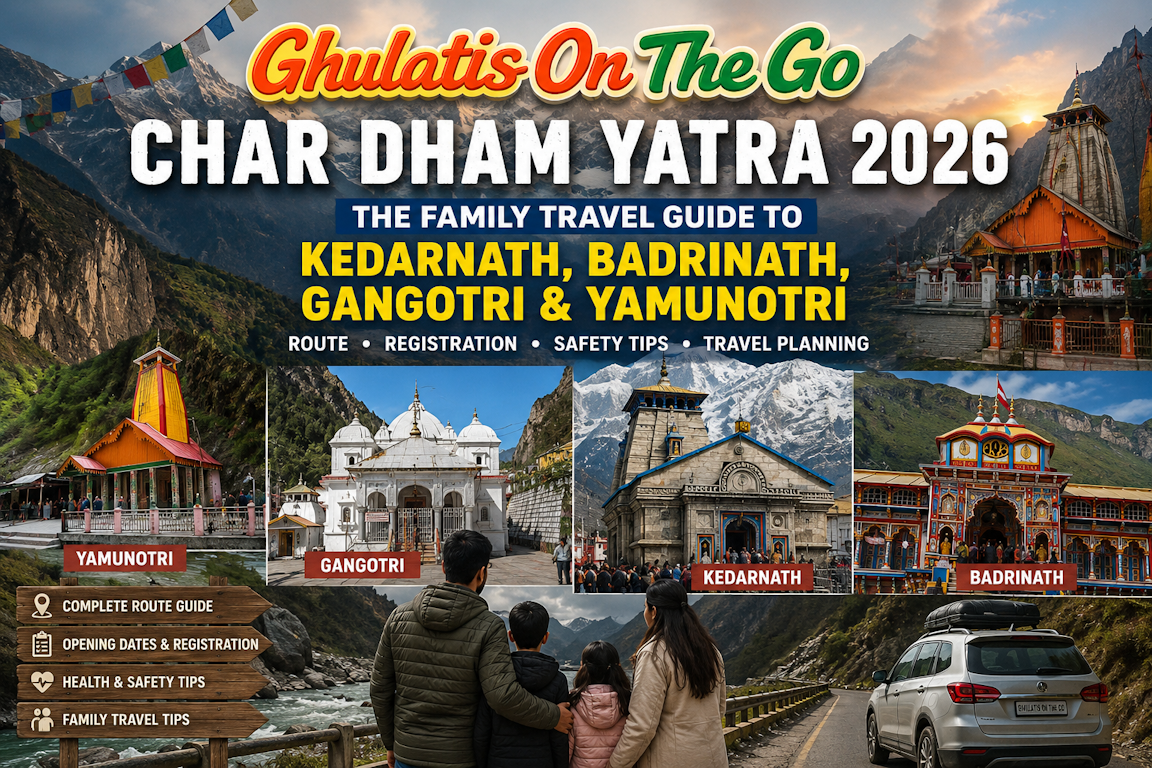
Char Dham Yatra 2026 is one of the most meaningful journeys a family can take in India, but it is also one of the trips that needs the most careful planning. The pilgrimage connects four sacred Himalayan shrines in Uttarakhand: Yamunotri, Gangotri, Kedarnath and Badrinath. Uttarakhand Tourism describes Char Dham as a pilgrimage to four holy sites nestled high in the Himalayas, and that one sentence explains why the journey is both beautiful and demanding. This is not a casual weekend road trip. It is a spiritual route through mountain roads, changing weather, high altitude, crowded paths, long driving days, and places where patience matters as much as planning.
For a family travel blog like Ghulatis On The Go, Char Dham Yatra 2026 is a powerful topic because it brings together faith, family, road travel, food stops, mountain scenery, health awareness, and real-world travel decisions. A Ghulati family style trip is not only about reaching a destination; it is about how the family gets there, what they learn on the way, how they manage children and elders, where they stop, what they eat, how they handle delays, and how they respect a place that is sacred to millions.
The 2026 season has already begun. The official Uttarakhand Tourist Care portal lists Yamunotri Dham and Gangotri Dham opening dates as 19 April 2026, Kedarnath Dham as 22 April 2026, and Badrinath Dham as 23 April 2026. These dates matter because Char Dham is seasonal. The high Himalayan shrines are not open year-round in the same way a city temple might be. Snow, winter weather, and mountain conditions shape the pilgrimage calendar, so families should always check official updates before building a travel plan.
The traditional Char Dham route is usually followed from west to east: Yamunotri first, then Gangotri, then Kedarnath, and finally Badrinath. eUttaranchal describes this clockwise direction as the traditional route, and it is also the sequence most travelers recognize when planning the full pilgrimage. For the Ghulati family audience, this matters because the route is not only spiritual; it is practical. It helps families understand the flow of the road journey, where to place overnight stops, and why rushing from one shrine to the next can create unnecessary stress.
Before beginning the yatra, registration is one of the most important steps. The official Uttarakhand Char Dham and Hemkund Sahib portal states that online registration has started and can be completed through the official website or the Android and iOS mobile applications. The same portal says that, under Uttarakhand government travel policy, travelers and vehicles must be registered before starting the journey, and verification is required at the destinations. This is not a small detail to leave for later. A family should treat registration as part of the trip foundation, along with transport, lodging, medicines, weather planning, and route research.
The official registration process is designed for individuals, families, and tour operators. The portal explains that travelers create a tour by selecting start and end dates, the number of tourists, the Dhams being visited, and the visit dates for each shrine. After pilgrim details are completed, travelers download and carry the Yatra Registration Letter. For a Ghulati family road trip, this is the kind of paperwork that should be saved in more than one place: printed copies, phone screenshots, email backup, and copies shared with another family member.
Yamunotri is often the first major shrine on the traditional Char Dham route. The official Uttarakhand Tourist Care page lists Yamunotri at an altitude of 3,293 meters and says the temple is connected with Surya Kund, a natural hot water spring, and Divya Shila, a sacred rock pillar worshipped before entering the shrine. The page also states that the road journey ends at Janki Chatti, the last motorable point, followed by a 6 km trek to Yamunotri Temple. That makes Yamunotri a major planning moment for families because even though the trek is shorter than Kedarnath, it still requires time, physical readiness, and crowd awareness.
For families traveling with elders or young children, Yamunotri should not be treated like a quick photo stop. The official page notes that travelers can use pony, palki, or doli options for the ascent from Janki Chatti. That does not remove the need for planning. A Ghulati family travel plan should still account for waiting time, weather, narrow paths, fatigue, hydration, and the return journey. The best family approach is to start early, avoid unnecessary baggage on the trek, carry warm and rain-friendly clothing, and keep the day flexible enough to avoid pressure.
Gangotri is usually the second shrine in the traditional sequence. The official Uttarakhand Tourist Care page lists Gangotri Temple at an altitude of 3,100 meters and says it is directly accessible by motorable roads, making it easier to reach than some other Char Dham sites. The page lists common road routes from Dehradun through Mussoorie, Uttarkashi and Harsil, and from Haridwar or Rishikesh through Chamba, Dharasu, Uttarkashi and Harsil. For a family, Gangotri may feel more road-accessible than Yamunotri or Kedarnath, but the altitude, long drive, and Himalayan weather still deserve respect.
Gangotri is also connected to the River Ganga and to nearby places such as Harsil, Gaumukh, Tapovan, Bhairon Ghati and Pandava Gufa, according to the official tourism page. A family blog should be careful here: not every nearby attraction is right for every traveler. Gaumukh, for example, is a trek from Gangotri and should not be casually added to a family Char Dham itinerary unless the group is physically prepared and has checked current permissions and conditions. The Ghulati family approach would be to keep the main pilgrimage realistic first, then add side trips only if time, health, weather, and official rules allow.
Kedarnath is often the most emotionally powerful and physically demanding part of the journey. The official Uttarakhand Tourist Care page lists Kedarnath at 3,580 meters and describes it as one of the twelve Jyotirlingas dedicated to Lord Shiva. The same page says Kedarnath is a key site in the Chota Char Dham pilgrimage. Because of its altitude, terrain, weather, and trek, Kedarnath is the shrine where families need to be especially cautious. It is not enough to simply book a hotel and arrive at the base point; the family needs to think through the trek, oxygen levels, health readiness, and emergency planning.
Kedarnath is also where the 2026 yatra has shown why planning matters. The New Indian Express reported on 17 May 2026 that more than 15.63 lakh pilgrims had visited the four shrines since 19 April, while 53 deaths had been reported, including 28 at Kedarnath. Health officials attributed most deaths to health-related complications such as heart attacks, high-altitude sickness, hypertension and extreme weather rather than accidents. The same report said the terrain, high altitude, lower oxygen levels and strenuous ascents create risks, especially for elderly pilgrims and people with pre-existing conditions.
That does not mean families should avoid the journey completely. It means families should respect the journey. The official Char Dham health advisory says all pilgrimage sites are in the high Himalayan region above 2,700 meters and that travelers may be affected by extreme cold, low humidity, ultraviolet radiation, low air pressure and low oxygen content. The advisory recommends planning a trip of at least seven days, allowing time to acclimatize, taking frequent breaks, practicing breathing exercises, walking daily before the trip, and getting a health check-up for travelers over 55 or those with a history of heart disease, asthma, hypertension or diabetes.
For the Ghulati family reader, this is the most important practical takeaway: Char Dham Yatra 2026 should be planned around the slowest and most vulnerable person in the group, not the fastest. If grandparents are traveling, the itinerary should be gentler. If children are traveling, food, restrooms, sleep, warmth and breaks become part of the plan. If someone has heart disease, breathing issues, diabetes, hypertension or other medical concerns, the health advisory’s message is clear: preparation and medical guidance matter before the yatra begins.
The official health advisory also lists warning symptoms that should not be ignored, including chest pain, shortness of breath or difficulty talking, persistent coughing, dizziness or disorientation, vomiting, icy or cold skin, and weakness or numbness on one side of the body. It says high altitude can cause severe medical issues and that quick action can save a life. This is why a family travel guide must say plainly that darshan should never be rushed at the cost of health. A Ghulati family journey should leave space for rest, medical stops, and the decision to pause or turn back if someone is not well.
The advisory also recommends carrying warm clothes such as woolen sweaters, thermals, puffer jackets, gloves and socks; rain gear such as raincoats and umbrellas; and basic health-check equipment such as a pulse oximeter and thermometer. It advises travelers with pre-existing conditions to carry all existing medication, testing devices and a home physician’s contact number. These details may sound basic, but they are the difference between a casual packing list and a responsible family pilgrimage plan.
The fourth shrine, Badrinath, is more road-accessible than Kedarnath, but it should not be underestimated. The official Uttarakhand Tourist Care page lists Badrinath Temple at an altitude of 3,133 meters, surrounded by the Nar and Narayan mountain ranges with the Alaknanda River nearby. It also says Badrinath is dedicated to Lord Vishnu and is one of the revered pilgrimage sites in the Char Dham Yatra in Uttarakhand. The official page lists common routes from Dehradun, Haridwar, Rishikesh, Kedarnath, Gangotri and Yamunotri, and notes that the 45 km road from Joshimath to Badrinath is scenic but landslide-prone, so travelers should check road conditions before traveling.
That Joshimath-to-Badrinath warning is the kind of detail families should not ignore. Mountain travel is different from highway travel in the plains. A drive may look manageable by distance but still take a long time because of road width, weather, landslide zones, traffic control, pilgrimage crowds, and driver fatigue. When the Ghulati family plans a route, the map should not be the only guide. Official weather alerts, local police updates, hotel confirmation calls, and road-condition checks should all be part of the morning routine.
The Char Dham route is a road trip, but it is also a high-altitude pilgrimage. That combination makes rest days and buffer time valuable. eUttaranchal lists the traditional sequence as Yamunotri, Gangotri, Kedarnath and Badrinath, and also describes a full Char Dham road journey as approximately 1,500 to 1,600 km depending on the starting point and travel plan. For families, this means the route is long enough that small delays can become major schedule problems. A one-day roadblock, a health issue, a weather warning, or a missed rest day can affect the whole itinerary.
Weather and landslides are not theoretical concerns. Times of India reported that a late-night landslide in the Munkatiya area between Sonprayag and Gaurikund blocked the Kedarnath Yatra route in May 2026, stranding pilgrims and requiring SDRF and NDRF teams to evacuate more than 10,000 people overnight. The report also said authorities advised pilgrims to plan cautiously and follow official updates because weather in the region can turn extreme without warning. For a family travel blog, this is one of the clearest reasons to recommend flexible planning instead of a packed, no-margin itinerary.
Crowds are another major part of Char Dham Yatra 2026. Times of India reported that Uttarkashi district officials were considering reviving the old Kharsali–Garudganga route to Yamunotri after severe congestion on the Janaki Chatti–Yamunotri trekking route. The report said the current route sees massive crowds during pilgrimage season, causing daily pedestrian traffic jams lasting several hours and creating a safety risk for pilgrims. This is why families should think about timing, early starts, patience, and crowd management before arriving at trek points.
A practical family itinerary should begin from Haridwar, Rishikesh or Dehradun depending on transport connections, available drivers, lodging, and group needs. Haridwar and Rishikesh are common starting points because many travelers can reach them by road or rail before entering the mountains. From there, the usual family-friendly flow is toward Barkot or nearby areas for Yamunotri, then Uttarkashi for Gangotri, then the Guptkashi/Sonprayag/Gaurikund side for Kedarnath, then Joshimath or Badrinath for the final shrine. Exact overnight stops should be chosen only after checking current road conditions, official updates and lodging availability.
Food planning also matters on this route. Families should expect simple vegetarian food near many pilgrimage areas and should carry safe snacks that do not spoil easily. The health advisory recommends drinking at least two liters of fluid and taking plenty of nutritious diet throughout the yatra. For the Ghulati family traveler, this means packing in a way that supports the journey: water, oral rehydration options if advised by a doctor, fruits that travel well, simple dry snacks, and food that suits elders and children.
It is also wise to keep caffeine, smoking, alcohol, sleeping pills and strong painkillers out of the journey unless a doctor has specifically advised something different. The official health advisory says not to consume alcohol, caffeinated drinks, sleeping pills and strong painkillers during the yatra, and to refrain from smoking. That advice is especially relevant at altitude, where breathing, hydration and alertness are important.
Transport choices should be made with safety in mind. Some families may choose a tour operator, some may hire a private vehicle with an experienced mountain driver, and some may use buses or shared transport. The official pages show that buses and taxis are available from major Uttarakhand cities for Yamunotri access, and that Gangotri and Badrinath can be reached by road through listed routes. The important point is not only what vehicle is used, but who is driving, how rested the driver is, whether the vehicle is suitable for mountain roads, and whether the family avoids driving in unsafe weather or late-night conditions.
For Kedarnath, some travelers consider helicopter services. The official IRCTC HeliYatra site states that helicopter ticket bookings for Shri Kedarnath Dham opened on 15 April 2026 at 6:00 PM for journeys from 22 April to 15 June 2026. Families should use only official channels and avoid social media shortcuts, random agents, or suspicious payment links. Times of India reported in April 2026 that Uttarakhand STF uncovered fake helicopter booking scams targeting Char Dham pilgrims, with fraudsters posing as representatives and creating bogus accounts and websites. For the Ghulati family audience, this is a strong warning: convenience should never replace verification.
A smart family packing list for Char Dham Yatra 2026 should focus on layers, health, documents and weather. Warm clothing is essential because all four shrines are high-altitude destinations. Rain protection is also important because mountain weather can change quickly. A pulse oximeter and thermometer are recommended by the official advisory. Personal medicines should be packed in the hand bag, not buried inside luggage. Registration letters, IDs, hotel confirmations, emergency contacts, vehicle details, and backup phone chargers should be organized before the journey begins.
The Ghulati family way to approach Char Dham is to treat every day as a balance between devotion and discipline. Wake up early, check the weather, confirm the road situation, keep snacks and water ready, avoid rushing elders, take breaks before fatigue becomes serious, and listen when someone says they do not feel well. In the mountains, small decisions become important. Leaving late can mean reaching after dark. Skipping food can affect energy. Ignoring a headache or dizziness can become dangerous. Overpacking can make treks harder. Not checking official updates can lead to avoidable delays.
Families should also understand that the Char Dham Yatra is not only about the temples. It passes through river valleys, confluences, mountain towns, forests, small markets, dhabas, guest houses, and places where local communities serve pilgrims every season. The journey includes sacred geography and everyday travel reality together. That is why a Ghulati family blog post should not make the yatra sound either too easy or too frightening. The honest message is that Char Dham can be deeply rewarding when planned with care.
For families with seniors, the safest mindset is slow travel. The official advisory specifically highlights special care for yatris who are over 55 years of age, pregnant women, patients with a history of heart disease, hypertension, asthma or diabetes, and obese patients with BMI above 30. This does not automatically mean every senior cannot travel, but it does mean health checks, doctor consultation, medicine planning, and realistic pacing are essential.
For families with children, the journey needs another layer of planning. Children may enjoy the mountains, rivers and road stops, but they may also struggle with long drives, cold weather, crowded paths, unfamiliar food, early mornings and limited restrooms. Parents should carry extra layers, simple snacks, basic hygiene supplies, motion-sickness support if recommended by a doctor, and entertainment for long road sections. A Ghulati family travel day should include rest stops before children become exhausted, not after.
For families coming from outside India, the yatra requires even more preparation. Road travel in Uttarakhand’s mountains can feel very different from road travel in the United States or other countries. Distances may look short but take longer than expected. Mobile signal may vary. Food choices may be simpler in remote places. Weather can change fast. Official registration, local rules, and temple customs should be checked before the trip. The Ghulati family travel style fits well here because it can explain the journey in plain language for people who may know India emotionally through family roots but still need practical details.
Respect is also part of preparation. Char Dham is a pilgrimage, not just a scenic vlog route. Families should dress respectfully, avoid littering, follow queue systems, listen to local authorities, and remember that many people around them are making the journey for deeply personal spiritual reasons. The Kedarnath route alone has also had major cleanliness concerns; Times of India reported that nearly 25 tonnes of waste had been collected along the Gaurikund-to-Kedarnath trekking route as part of an ongoing cleanliness and eco-friendly pilgrimage campaign. That detail should remind every traveler that responsible travel is not optional in fragile Himalayan areas.
A realistic Char Dham Yatra 2026 family plan should include buffer days. It should avoid back-to-back extreme travel days when elders or children are involved. It should keep Kedarnath as a major physical day rather than just another stop. It should treat Yamunotri as a trek day, Gangotri as a long mountain-road day, and Badrinath as a high-altitude road journey with landslide-prone sections near Joshimath. It should also keep a backup plan for weather delays, route restrictions and health concerns.
The best time to go depends on official opening dates, weather, crowd levels and family needs. The early season may bring excitement and fresh conditions, but also cold weather and rush around openings. The monsoon period can bring heavy rain and landslide risk in the Himalayas, so families should be extremely careful and follow official alerts. Later in the season, weather and closure timing become important. Because conditions can change, a responsible blog should not promise one perfect travel window for everyone. Instead, families should check official portals, local advisories and current forecasts before deciding.
A family should also decide whether to complete all four Dhams in one trip or split the journey. Many pilgrims want the complete route in one yatra, but not every group has the same time, health, budget or stamina. A Ghulati family with elders may choose a slower full route, while another family may decide to visit two shrines first and return later for the others. The pilgrimage is sacred, but safe planning should guide the pace.
The emotional side of Char Dham Yatra is what makes it unforgettable. Yamunotri connects travelers with the source of the Yamuna. Gangotri connects them with the sacred Ganga tradition. Kedarnath brings devotion to Lord Shiva in one of India’s most dramatic mountain settings. Badrinath brings the journey to Lord Vishnu’s Himalayan shrine beside the Alaknanda. For many families, these are not simply places on a map; they are names heard from parents, grandparents, prayers, stories and childhood memories.
That is why Char Dham Yatra 2026 is such a strong topic for Ghulatis On The Go. It speaks to families who love travel, but it also speaks to families who want travel to mean something. It can help readers understand that the route is beautiful, but not effortless; sacred, but not simple; popular, but still serious; and possible for many families when planned with patience.
The Ghulati family lesson from this guide is simple: do not rush the Himalayas. Register properly. Check official dates. Respect altitude. Prepare health documents and medicines. Pack warm and rain-ready clothing. Use verified booking platforms. Start early. Keep buffer days. Watch the weather. Listen to the body. Follow local instructions. Leave no waste behind. Make the journey about faith, family and safety together.
Char Dham Yatra 2026 can become one of the most memorable family journeys in India because it brings four sacred destinations into one unforgettable Himalayan route. Kedarnath, Badrinath, Gangotri and Yamunotri each offer something different, but the real experience happens between them: the mountain roads, the early morning starts, the tea stops, the prayerful silence, the crowded paths, the family conversations, and the shared feeling of reaching somewhere that matters. For the Ghulati family and for any family planning this yatra, the best journey is not the fastest one. It is the one planned with care, completed with respect, and remembered with gratitude.