

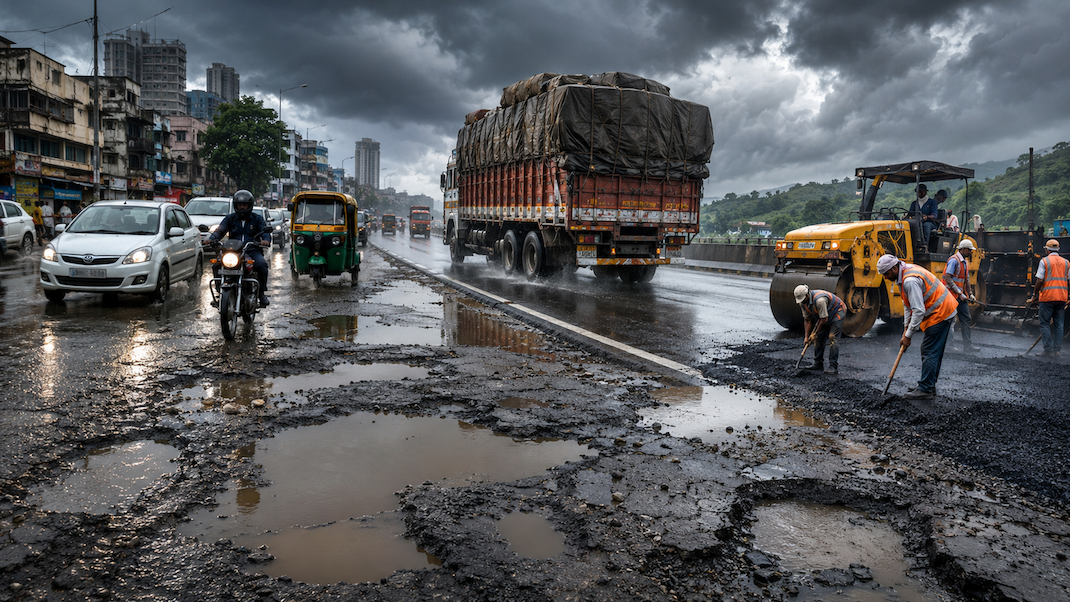
India’s roads are among the most visible signs of the country’s growth. New highways, expressways, flyovers, bypasses, and urban roads are being built across the country. The National Highway network has grown significantly in recent years, with the Ministry of Road Transport and Highways reporting that the NH network increased from 91,287 km in 2014 to more than 146,000 km by 2025.
Yet many people still ask the same question after every monsoon: Why do roads in India go bad so soon?
The answer is not as simple as saying “bad materials” or “poor construction.” Some roads are built well and last. Others fail early. Based on government data, road engineering guidance, and documented maintenance issues, the real reason is usually a combination of factors: water, drainage, traffic loading, construction quality, repeated digging, and reactive maintenance.
Roads Do Not Fail Only at the Surface
A road may look like a simple black asphalt surface, but the real strength is below what drivers see. A typical flexible pavement depends on several layers: the natural soil or subgrade, sub-base, base course, bituminous layers, shoulders, side drains, culverts, and surface slope.
When the top surface cracks, the visible pothole is often only the final symptom. The damage may have started deeper in the pavement structure. Water may have entered the lower layers. The soil may have weakened. The aggregate may have lost support. The bitumen may have separated from the stones. Heavy vehicles may then press the weak section repeatedly until the surface collapses.
This is why a road can look newly built and still fail quickly. A smooth black surface does not guarantee that the base, compaction, drainage, and load capacity are correct.
The Monsoon Is One of the Biggest Tests for Indian Roads
Water is one of the most destructive forces for asphalt roads. When rainwater sits on the road or enters through cracks, it weakens the bond between bitumen and aggregate, reduces the strength of the base layers, and can eventually create potholes. Pavement engineering sources describe moisture as a major cause of asphalt distress because water can weaken the asphalt binder-to-aggregate bond and lead to stripping.
India’s monsoon makes this issue more severe. A road that may survive normal weather can fail quickly when exposed to heavy rain, standing water, blocked drains, and repeated traffic loading.
The National Highways Authority of India’s own monsoon-preparedness work shows how important water management is. In 2025, NHAI said it was cleaning and desilting rainwater-harvesting structures, fixing drains and outlets, repairing potholes, desilting culverts and cross drains, and cleaning drainage systems in areas with a history of flooding and waterlogging.
That official focus tells us something important: road durability is not only about asphalt. It is also about whether water can escape quickly.
Poor Drainage Turns Small Cracks Into Big Potholes
Drainage is one of the most important parts of road life. If water cannot leave the pavement surface, it will find a way into the road structure. If side drains are clogged, culverts are blocked, shoulders trap water, or the road slope is wrong, rainwater remains on or under the pavement.
Once water enters the pavement, traffic makes the damage worse. Vehicle tires push water into cracks under pressure. The base becomes soft. The road loses support. A small crack becomes a depression. A depression becomes a pothole.
The Federal Highway Administration explains that excessive moisture inside a pavement structure can adversely affect pavement performance, and materials that are stable at one moisture level can become unstable when saturated.
In simple terms: a road is only as strong as its drainage.
Overloaded Trucks Can Destroy Pavement Life Faster Than Expected
Passenger cars do not damage roads nearly as much as heavy commercial vehicles. Pavement damage is strongly connected to axle loads, not just the total number of vehicles. The widely used “fourth power” pavement concept comes from road engineering research and explains that pavement wear rises very sharply as axle load increases. Even though exact damage varies by pavement type and condition, the relationship between axle load and pavement damage is not linear.
This matters in India because roads carry large volumes of freight traffic. If trucks are overloaded, the pavement may experience far more stress than it was designed for. A road designed for a certain traffic load may fail early if it regularly carries heavier axle loads.
MoRTH’s Road Accidents in India 2023 report also identifies overloaded or hanging-load vehicles as a road safety issue. In 2023, overloaded or hanging-load vehicles accounted for 5.8% of total accidents, 7% of total persons killed, and 6% of injured persons in the load-condition category.
For pavement life, the key point is even broader: heavy axle loads accelerate fatigue, rutting, cracking, and deformation.
Construction Quality Matters Below the Surface
Roads can fail early when construction quality is weak. Common technical problems include poor compaction, inadequate layer thickness, weak subgrade preparation, improper bitumen mix temperature, bad aggregate quality, poor bonding between layers, and rushed work during unsuitable weather.
There is also official evidence that quality and accountability problems exist on some National Highway stretches. In a March 2026 Lok Sabha response, MoRTH stated that since 2019, major deficiencies had been reported in 96 National Highway projects or stretches. The response said actions against defaulting agencies can include termination, penalties, liquidated damages, debarment, blacklisting, or declaring agencies as non-performers.
Another official response listed examples of rutting, cracks, surface deformation, distress after rains, and contractor penalties on specific highway projects.
This does not mean every road failure is due to bad construction. But it does show that construction defects and delayed maintenance are documented problems, not just public perception.
Potholes Are Not Just an Inconvenience
Potholes are often discussed as a comfort issue, but they are also a safety issue. MoRTH’s Road Accidents in India 2023 report recorded 4,80,583 road accidents, 1,72,890 deaths, and 4,62,825 injuries in 2023. The same report stated that these figures translate to an average of 1,317 accidents and 474 deaths every day.
In the road-feature category, potholes were linked to 5,840 accidents, 2,161 deaths, and 5,309 injuries in 2023. Compared with 2022, pothole-related accidents increased by 31.4%, deaths by 16.4%, and injuries by 42.2%.
That data makes one point very clear: potholes are not just a maintenance issue. They are a public safety issue.
National Highway Data Does Not Always Capture the Full Pothole Problem
One important fact is that pothole data can be difficult to separate by road category. In a December 2024 Lok Sabha response, MoRTH stated that the total number of road accidents caused by potholes on National Highways specifically was not available. However, it reported that on all categories of roads, accidents under the “potholes” road-feature category were 3,625 in 2021 and 4,446 in 2022.
This matters because India’s roads are managed by different agencies. National Highways, State Highways, municipal roads, rural roads, and urban roads may fall under different authorities. When responsibility is fragmented, pothole repair and long-term accountability can become harder.
Utility Cuts Can Weaken Even Newly Built Roads
In cities, roads are often cut after construction for water pipelines, sewer lines, gas lines, electricity, telecom, or internet cables. A newly paved road may be dug up within months. If the trench is not restored with proper compaction and layer-by-layer reinstatement, that section becomes structurally weaker than the rest of the road.
This is not just theory. Municipal authorities such as Mumbai’s BMC have trenching and reinstatement policies because utility cuts require formal restoration procedures. BMC’s trench policy includes requirements for reinstatement when trenches are taken on different road types.
Poor trench restoration creates uneven settlement. During rain, water collects around the cut. Under traffic, the weak patch sinks. Eventually, it becomes a pothole or a broken strip across the road.
Patch Repairs Often Treat the Symptom, Not the Cause
Many roads are repaired by filling visible potholes. That may be necessary for immediate safety, but it does not always solve the structural problem.
If the base layer is wet, loose, or damaged, a surface patch will fail again. If water is still entering the same crack, the new patch will break. If drainage is still blocked, the same section will deteriorate during the next rain.
This is why some potholes return again and again. The visible hole may be filled, but the underlying failure remains.
The Federal Highway Administration describes pavement preservation as planned work to keep roadways in good repair, improve or sustain condition, extend pavement life, reduce user delays, and improve safety and mobility.
The lesson is simple: preventive maintenance is usually better than emergency patching.
Maintenance Must Happen Before the Road Looks Bad
A road does not suddenly fail overnight. Most failures begin with small signs: hairline cracks, blocked drains, edge breaks, rutting, water ponding, shoulder settlement, or utility cuts. If these are repaired early, the road can last longer. If they are ignored, the cost and difficulty of repair increases.
World Bank transport guidance has warned that if road defects are neglected, an entire road section may eventually require full reconstruction at three times or more the average maintenance cost; the same guidance cites examples where delayed maintenance can multiply costs many times over.
That is why road agencies need regular inspection, drain cleaning, crack sealing, shoulder repair, resurfacing, and condition-based maintenance before the monsoon—not only after public complaints.
Black Spots and Engineering Defects Need Long-Term Fixes
Some road sections are dangerous not only because of potholes but because of geometry, missing signage, poor merging design, unsafe junctions, lack of barriers, unauthorized median openings, or poor visibility.
In a 2026 Lok Sabha response, MoRTH stated that 16,542 black spots had been identified on National Highways. Short-term rectification had been completed at 14,138 black spots, while long-term measures had been completed at 6,649 black spots. The response also stated that long-term measures can include geometric improvements, junction improvements, spot widening, underpasses, and overpasses.
This shows that road safety and road durability are connected. A road must be designed, maintained, drained, and monitored as a system.
Why Some Roads Last and Others Fail Quickly
Not all Indian roads fail quickly. Some highways and city roads are well-built and perform well. The difference usually comes down to whether the road has:
proper pavement design for expected traffic,
good subgrade preparation,
adequate compaction,
quality materials,
working drainage,
controlled axle loads,
well-restored utility cuts,
regular inspections, and
timely preventive maintenance.
When those things are missing, even a new road can deteriorate quickly.
What Would Make Indian Roads Last Longer?
The solution is not only “use better asphalt.” Better asphalt helps, but road life depends on the full system.
India needs stronger focus on:
Drainage-first road design
Every road should be built and maintained so water leaves quickly. Side drains, culverts, crossfall, shoulders, and water outlets should be treated as core road assets, not secondary features.
Better quality control during construction
Layer thickness, compaction, asphalt temperature, material quality, and subgrade strength must be verified during construction, not after the road fails.
Stricter control of overloaded vehicles
Axle-load enforcement and weigh-in-motion systems can reduce pavement stress and improve road life.
Better trench and utility coordination
Road cutting should be coordinated before resurfacing. If a trench is unavoidable, reinstatement should match the original pavement structure.
Preventive maintenance before monsoon
Crack sealing, drain desilting, shoulder repairs, and surface treatments should happen before heavy rain.
Transparent public condition tracking
Road condition data, contractor defect-liability status, repair deadlines, and maintenance history should be easier for the public to track.
Conclusion: Indian Roads Fail Early When Water, Load, and Maintenance Gaps Combine
Roads and highways in India often go bad quickly because the visible surface is only the final layer of a much larger system. The deeper causes are usually water infiltration, poor drainage, heavy axle loads, construction defects, utility cuts, and delayed maintenance.
The monsoon exposes these weaknesses, but it does not create all of them. A road that is properly designed, compacted, drained, protected from overloading, and maintained before damage spreads can last much longer.
The real goal should not be to keep repairing potholes after they appear. The goal should be to build and maintain roads in a way that prevents potholes from forming in the first place.