

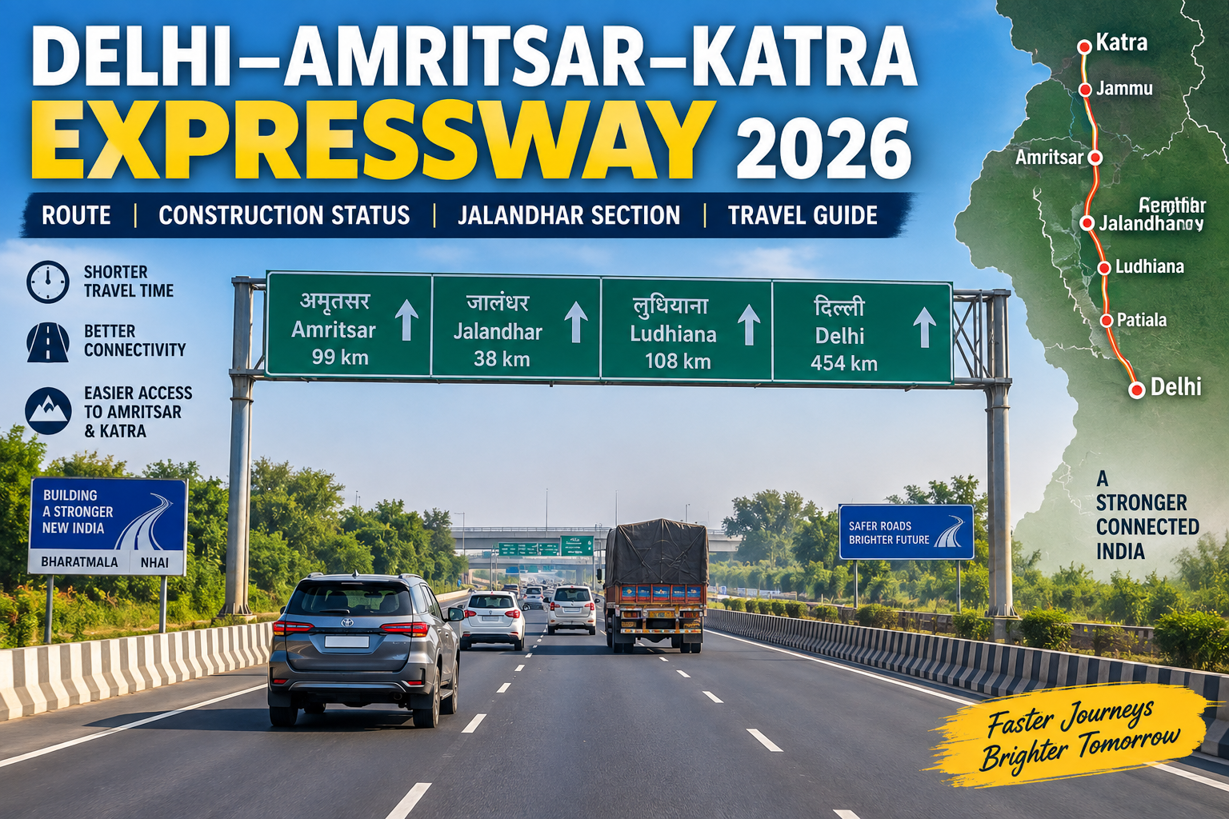
This is the Delhi Amritsar Katra Expressway, often shortened to the DAK Expressway, one of the biggest greenfield road projects underway in northern India. It is meant to cut the Delhi to Katra journey from about 727 kilometres down to roughly 588 kilometres, and from around fourteen hours to about six. It is also meant to bring Amritsar within four hours of the capital. Those numbers get repeated in almost every headline about this project, but they describe the finished road, not the one that exists on the ground right now in September 2026. This piece walks through the whole picture, with a close focus on the Punjab stretch and the Jalandhar section specifically, since that is where the project has run into its biggest difficulties and where a lot of the confusion for ordinary travellers comes from.
The Delhi Amritsar Katra Expressway is a greenfield and brownfield hybrid, meaning some of it is being built as an entirely new road cutting through farmland, and some of it upgrades and widens existing highway alignments, particularly in the Jammu and Kashmir stretch. It falls under the Bharatmala Pariyojana, the central government's umbrella highway development programme, and it is being executed by the National Highways Authority of India.
The idea was first floated years before construction began. The detailed project report was prepared by Feedback Infra and completed in November 2019, and land acquisition started in January 2020, covering an estimated 14,000 acres in Punjab and about 5,000 acres in Haryana. Prime Minister Modi laid the foundation stone on April 24, 2022. At that point, NHAI's public target was a completion date of October 2023.
That original deadline has been revised many times since. It moved to 2024, then to various points in 2025 and 2026, with individual packages carrying their own separate target dates depending on how far along their land acquisition and construction had progressed. Union minister Nitin Gadkari has updated Parliament on this project's timeline more than once, and each time the completion window has shifted a little further out, mostly because of what has happened in Punjab. The pattern is worth keeping in mind for the rest of this piece: whatever completion date is quoted at any given moment, including the ones in this article, should be treated as the current best estimate rather than a fixed promise.
The project is split into 21 separate construction packages in total. Based on figures Gadkari gave in Parliament, five of these packages cover Haryana, eight cover the main Punjab alignment, three more cover the Amritsar spur (which also runs entirely through Punjab), and the remaining five cover Jammu and Kashmir. In other words, eleven of the twenty one packages, more than half the entire project, sit inside Punjab. That single fact goes a long way toward explaining why Punjab has become the section everyone watches most closely.
The Complete Route, State by State
The expressway does not actually begin inside Delhi. Its southern end is near Jasaur Kheri and Nilauthi villages in Jhajjar district, Haryana, just past the Bahadurgarh border, where it connects into the Kundli Manesar Palwal Expressway, also known as the Western Peripheral Expressway. From there it runs north through Haryana for roughly 135 to 137 kilometres, passing near Rohtak (via Hassangarh), through Sonipat district close to Kharkhoda and Gohana, then on to Jind and Kaithal before crossing into Punjab.
Once inside Punjab, the road runs through a long list of districts: Patiala, Sangrur, Malerkotla, Ludhiana, Jalandhar, Kapurthala, Tarn Taran, Amritsar and Gurdaspur. Government figures presented to Parliament put the total Punjab length, including the Amritsar spur, at about 399 kilometres, while other project trackers describe the core mainline alignment through Punjab as closer to 295 to 296 kilometres, with the 99 kilometre spur counted separately. Both figures describe the same road, just measured slightly differently.
The most important junction on the whole corridor sits near the town of Nakodar in Jalandhar district. This is where the expressway splits in two. One branch, the NE 5A spur, turns west and northwest, running about 99 kilometres through Sultanpur Lodhi, Goindwal Sahib, Khadoor Sahib and Tarn Taran before ending near Sri Guru Ram Das Ji International Airport at Amritsar. The other branch, the main NE 5 alignment, continues north through Kapurthala and Gurdaspur, then toward Pathankot and across into Jammu and Kashmir, passing through Kathua and Samba and around Jammu on the Jammu Ring Road, before finally reaching Katra in Reasi district, the base town for pilgrims heading up to the Vaishno Devi shrine.
The Jammu and Kashmir stretch covers roughly 135 to 144 kilometres depending on the source, and it is the most technically demanding portion of the project, involving several major river bridges over the Ravi, Ujh, Tarnah and Basantar rivers and a shorter tunnelled section through the Himalayan foothills near Udhampur.
The Punjab Route in Detail: Why This Is the Section That Slowed Everything Down
If you want to understand why the Delhi Amritsar Katra Expressway has taken so much longer than originally planned, you need to understand what happened in Punjab.
Land acquisition in the state ran into sustained resistance almost from the start. Farmer groups, including factions of the Bhartiya Kisan Union, blocked survey and acquisition work at multiple points across Patiala, Sangrur, Malerkotla, Ludhiana, Jalandhar, Kapurthala, Tarn Taran, Amritsar and Pathankot, arguing that the compensation on offer was too low. This was not a brief dispute. It dragged on for years, with NHAI at one point writing to the Punjab government warning that even a single unresolved land gap anywhere along a greenfield corridor like this one would leave the entire road unusable, since there would be no way to detour around a missing stretch. By August 2024, NHAI reported that land acquisition across roughly 230 kilometres of the 295 kilometre Punjab requirement had been completed in eleven of thirteen affected districts, with Ludhiana and Gurdaspur still lagging behind.
Land was only part of the problem. Once contracts were underway, several stretches ran into a separate obstacle: a shortage of construction material caused by National Green Tribunal restrictions on sand and gravel mining in Punjab, compounded by the state repeatedly revising its own mining policy. Contractors also complained of financial strain from unpaid pond ash transport costs owed by state run thermal power plants, since pond ash is used as fill material in embankment construction. The combination of stalled land, material shortages and payment disputes proved fatal for some contracts. In 2026, NHAI formally terminated three Punjab packages, numbered 8, 10 and 11 in the original tender structure, after the contractor's progress ground to a near standstill. NHAI released more than ₹1,500 crore for work already completed on these packages and paid a further settlement of roughly ₹265 crore to close out the contracts, with the combined value of the three packages exceeding ₹3,000 crore. That work is now being retendered, which means fresh contractors will need to be found and mobilised before construction on those stretches can resume in earnest.
To put a number on it, one project tracker described Punjab's overall completion level in 2024 at only around 43 percent, well behind the 80 to 90 percent being reported for Haryana and Jammu and Kashmir at the same time. By the middle of 2026, Punjab's progress had improved considerably, with various summaries describing the state's section as roughly 90 percent advanced, but that figure needs to be read alongside the fact that three substantial packages had just been terminated and sent back out to tender. A percentage complete figure and a functioning, drivable road are not always the same thing, and Punjab is the clearest illustration of that gap anywhere on this project.
The one genuinely large piece of good news for Punjab arrived on July 17, 2026, when Prime Minister Modi, after dedicating a 157.92 kilometre stretch in Haryana at a ceremony in Jind, travelled to Jalandhar the same day to inaugurate a further 30.9 kilometre stretch of the corridor. Together the two openings covered 188.82 kilometres, the single biggest jump in usable road length the project had seen in one day since construction began.
The Jalandhar Section: The Details That Matter Locally
Jalandhar district sits right at the hinge point of this entire project, since it contains the Nakodar junction where the road splits toward Amritsar and toward Katra. That makes the Jalandhar section unusually important, even though it is not the longest stretch in Punjab.
According to the district administration's own land acquisition notice, issued in October 2023, about 68 kilometres of the expressway corridor lies within Jalandhar district, spread across the Phillaur, Nakodar and Jalandhar II subdivisions, with roughly 29 kilometres running through Phillaur and Jalandhar II combined and about 10 kilometres through Nakodar. To build this stretch, the district issued a formal notification to acquire 1,485 acres of land. Because the entire corridor is access controlled by design, meaning vehicles cannot simply turn on and off it the way they can on an ordinary highway, the district's Deputy Commissioner at the time confirmed that Jalandhar would have only two access points onto the expressway for the whole district.
In terms of the original 2021 package structure, several packages touch Jalandhar directly. Package 9 runs from Mullanpur Dakha through Nakodar to a village called Kang Sahbu, a stretch of about 34 kilometres that enters Jalandhar district around Nakodar. Package 10 continues from Kang Sahbu in Jalandhar to Khojewal in neighbouring Kapurthala district, a shorter stretch of roughly 15.5 kilometres. The Amritsar spur also begins inside Jalandhar district, with its first package running about 41 kilometres from Nakodar to Dhunda village in Tarn Taran district. Package 9 was reported in the middle of 2026 to be nearing completion, having reached more than 65 percent physical progress at one point in its recent history, while Package 10 was one of the three packages NHAI later terminated for poor performance, with NHAI's own description of that contract explicitly naming the Jalandhar to Moga and Jalandhar to Kapurthala sections, along with Amritsar connectivity, as the affected scope.
The July 17, 2026 inauguration is the most tangible progress the Jalandhar section has seen. News coverage of that day's ceremony consistently described the 30.9 kilometre stretch opened near Jalandhar as Package 6 under NHAI's current numbering, opened on the same day as the 157.92 kilometre Haryana dedication. It is worth being transparent here: NHAI has retendered and renumbered some Punjab packages since the original 2021 award round, following the terminations described above, so package numbers referenced in different news reports from different years do not always map perfectly onto each other. What is consistent across every source is the physical fact that a meaningful, newly built stretch of expressway near Jalandhar opened to traffic in July 2026, alongside the Haryana dedication.
For residents and daily commuters in and around Jalandhar, the practical takeaway is this: a real, functioning piece of the expressway now exists close to the city, but it connects into a corridor that is still a patchwork of finished road, active construction sites and retendered gaps on either side. Anyone using the Jalandhar stretch today should expect to merge back onto the Grand Trunk Road or other existing highways at some point on either side of it, rather than experiencing an unbroken expressway drive.
Construction Status Overall: Where Things Stand State by State
Haryana. This was the first section to reach a usable state, with parts of the 135 to 137 kilometre stretch carrying traffic in some form since around November 2024. The formal, full dedication of a 157.92 kilometre stretch covering Packages 1 through 5 happened on July 17, 2026, at a ceremony in Jind attended by Haryana's chief minister and the union railways minister, at a reported cost of about ₹9,680 crore for that stretch. Haryana is, by a wide margin, the most complete part of this project.
Punjab. As described above, Punjab has been the genuine bottleneck. The 30.9 kilometre stretch near Jalandhar opened in July 2026 is the clearest sign of forward motion, but three packages (8, 10 and 11) were terminated in 2026 and are being retendered, meaning fresh construction timelines will need to be set once new contractors are on board. Various sources place Punjab's overall target completion somewhere between December 2026 and March 2027, though given the project's history, this should be read as an aspiration rather than a certainty.
Jammu and Kashmir. This stretch, covering roughly 135 to 144 kilometres, has faced its own complications, including terrain challenges, monsoon flooding in the region in the recent past, and broader disruptions in the border area. As of mid to late 2026, NHAI's public position placed full completion of the Jammu and Kashmir section at around August 2027, with the Devak bridge near AIIMS Vijaypur already open to traffic as one of the completed pieces.
Overall corridor. Taken together, industry trackers have described the project as somewhere around 75 to 80 percent complete by the middle of 2026, with NHAI's stated target for the full corridor sitting at March 2027. Given how many times this project's deadlines have shifted since 2019, from October 2023 to 2024, then through several 2025 and 2026 dates, and now to 2027, the most honest thing that can be said is that the road is visibly, measurably closer to completion than it has ever been, while a firm, final date remains difficult to guarantee.
Toll Rates: What Is Confirmed and What Is Not
Tolling has already begun on the operational Haryana stretch, using a boothless system based on FASTag and RFID technology, similar to the system used on the KMP Expressway. There are eight toll plazas spread across the 135 kilometre Haryana section, spaced roughly every 15 to 20 kilometres. The confirmed rates on this stretch are as follows.
Vehicle category One way Round trip
Car or jeep (light motor vehicle) ₹240 ₹360
Light commercial vehicle ₹385 ₹580
Two axle bus or truck ₹805 ₹1,210
Three axle commercial vehicle ₹880 ₹1,320
For the full Delhi to Katra journey once the entire corridor is open, NHAI has not yet published an official toll structure. Some project trackers have estimated a full one way car journey could cost somewhere in the region of ₹800 to ₹1,100 based on the per kilometre rate already in force in Haryana, but this figure is an estimate made by outside analysts, not an announced government rate, and travellers should treat it accordingly until NHAI issues a formal notification covering the complete route.
Travel Time: The Promise Versus the Present
The headline numbers for this project are consistent across every official statement. The existing route between Delhi and Katra via the Grand Trunk Road and National Highway 44 covers about 727 kilometres and typically takes 13 to 14 hours. Once the full expressway is open, that trip is expected to shrink to about 588 kilometres and roughly 6 hours, a saving of around 139 kilometres and 7 to 8 hours. Delhi to Amritsar via the NE 5A spur is expected to drop from around 8 hours today to about 4 hours, covering roughly 405 kilometres.
It is worth repeating a caution that NHAI's own recent messaging has acknowledged: these are corridor level design targets, not guaranteed door to door travel times. Actual journey time will depend on traffic conditions, weather, how many entry and exit points a traveller uses, and critically, how much of the corridor is actually complete on the day of travel. As of September 2026, a Delhi to Katra or Delhi to Amritsar trip still involves a mix of finished expressway sections, particularly in Haryana and around Jalandhar, and stretches where a driver will need to use the existing Grand Trunk Road, National Highway 44, or local diversions to bridge the gaps. Until the remaining Punjab packages and the full Jammu and Kashmir stretch are complete, the six hour and four hour figures remain a target for the finished road rather than a description of today's actual drive.
Safety Features and Traveller Amenities
Once fully built, the corridor is designed with a fairly comprehensive set of safety and convenience features, based on NHAI's stated specifications for the project. These include high mast LED lighting at interchanges and major junctions, emergency call booths positioned roughly every 5 kilometres and linked to a round the clock helpline, trauma centres, ambulances and fire response units stationed at intervals along the route, and speed cameras and surveillance systems across the corridor. To reduce the risk of collisions with stray animals, a persistent hazard on Indian highways, the design includes boundary fencing and dedicated animal crossing structures. Tolling throughout is boothless, using FASTag and RFID technology, so there are no manual cash lanes to queue at. Bus bays, truck stops, food courts and green medians are planned at major interchanges. One notable engineering feature on the Punjab stretch is a cable stayed bridge over the Beas River, reported to be about 1,300 metres long, among the more significant structures on the entire corridor.
The speed limit on completed, fully access controlled sections is 120 kilometres per hour for light vehicles such as cars and jeeps, and 80 kilometres per hour for heavier vehicles including buses and trucks.
Religious and Cultural Landmarks Along the Way
Few Indian highway projects connect this many significant religious sites in a single corridor. On the Amritsar spur, the road runs near Sultanpur Lodhi, associated with the early life of Guru Nanak Dev Ji, Goindwal Sahib, home to the Baoli Sahib Gurudwara built under Guru Amar Das, Khadoor Sahib, linked to Guru Angad Dev Ji, and Tarn Taran Sahib, home to one of the largest gurdwara sarovars in the Sikh tradition, before reaching Amritsar itself and the Golden Temple, formally known as Sri Harmandir Sahib. There are also stated plans for a future loop connection toward Dera Baba Nanak and the Kartarpur Corridor, though this remains a longer term proposal rather than a funded, under construction piece of the project.
On the main alignment toward Jammu and Kashmir, the destination is Katra, the base town for the Vaishno Devi shrine in the Trikuta Hills. According to the Shri Mata Vaishno Devi Shrine Board, the shrine drew close to 9.5 million pilgrims in 2024 alone, the third consecutive year the figure crossed 9 million, making it one of the most visited pilgrimage sites in the country. The Shrine Board's own leadership has publicly linked improved road and rail connectivity, including this expressway, to their expectation of continued growth in pilgrim numbers in the years ahead.
Why This Road Matters Beyond Individual Travel
The economic case for this expressway extends well past faster pilgrimage trips. The corridor is designed to align with the Ludhiana Delhi Kolkata Industrial Corridor, one of eleven national industrial corridors identified by the government, and it is expected to meaningfully reduce congestion on the Grand Trunk Road, one of India's oldest and busiest highways, by giving long distance freight and passenger traffic an alternative route. It also strengthens road connectivity to border districts in Jammu and Kashmir, which carries strategic as well as commercial significance. Some industry estimates suggest more than a million trucks a year could eventually shift onto this corridor from existing highways, which would meaningfully cut logistics costs for businesses across Punjab and Haryana. There have also been reported discussions about eventually developing part of this corridor as an electric freight route with overhead charging infrastructure for heavy trucks, though this remains at the discussion stage rather than a confirmed, funded plan, and should be treated as a possibility to watch rather than a settled fact.
What Every Driver Should Know Before Using This Route
If you are planning to drive any part of the Delhi Amritsar Katra Expressway in its current, partially complete state, a few practical points are worth keeping in mind.
Carry a working FASTag with sufficient balance. The operational sections use a boothless, FASTag based tolling system with no cash lanes, so a low balance or a malfunctioning tag can cause real delays at entry and exit points.
Do not assume the whole route is expressway standard yet. Large parts of the corridor, especially in Punjab beyond the Jalandhar stretch and in much of Jammu and Kashmir, are still under construction or awaiting retendering. Expect to merge onto the Grand Trunk Road, National Highway 44, or local diversions at multiple points, and build extra time into your journey rather than assuming the advertised six hour figure applies today.
Respect the posted speed limits. On completed, access controlled sections the limit is 120 kilometres per hour for cars and 80 kilometres per hour for buses and trucks. These limits exist partly because entry and exit points are limited by design, and unexpected merging traffic can appear with little warning near interchanges.
Plan fuel, food and rest stops in advance. Because the road is access controlled, you cannot simply pull off wherever you like the way you might on an ordinary highway, and full amenity infrastructure such as food courts and fuel stations is still being built out along several stretches. Fill your tank and plan breaks around known interchanges rather than assuming facilities will appear when needed.
Take winter fog in Punjab seriously. Punjab and Haryana experience dense fog through much of December and January, particularly near canals, drains and low lying fields, conditions that have historically been linked to a disproportionate share of highway accidents in this region. Use fog lamps and low beams rather than high beams, brake gently rather than suddenly, watch for electronic warning signs about reduced visibility, and if visibility drops to near zero, pull over at a safe, designated spot rather than continuing to creep forward.
Save the NHAI helpline number, 1033. This toll free, 24 hour number connects road users to ambulance, patrol vehicle and crane assistance on NHAI managed stretches, and it is worth having saved in your phone before a long trip on any national highway or expressway in India, including this one.
Carry your documents. A valid registration certificate, driving licence, insurance and pollution certificate remain necessary even on access controlled roads, since enforcement checks still occur.
Check the latest status before you travel. Because this project is opening in phases, with new stretches becoming usable every few months, the safest approach is to check recent news or NHAI's own updates shortly before a long trip, rather than relying on any single article, including this one, as a permanently accurate picture.
If you are heading to Vaishno Devi, remember the expressway only gets you to Katra. Pilgrims still need to register separately with the Shri Mata Vaishno Devi Shrine Board and typically require an RFID card to proceed on the actual pilgrimage route, which is separately regulated and currently capped at 50,000 pilgrims a day under National Green Tribunal guidelines.
A Few Common Questions
Is the expressway open right now? Parts of it are. The Haryana section has carried traffic in some form since late 2024 and was formally, fully dedicated in July 2026, alongside a 30.9 kilometre stretch near Jalandhar in Punjab. The rest of Punjab and the Jammu and Kashmir stretch remain under construction or awaiting retendering.
Does the expressway go through Amritsar? Yes, via the separate NE 5A spur that branches off near Nakodar in Jalandhar district and runs about 99 kilometres to Sri Guru Ram Das Ji International Airport at Amritsar.
Why has Punjab taken so much longer than Haryana? A combination of prolonged land acquisition disputes with farmer groups, construction material shortages tied to mining restrictions, and contractor performance problems that led NHAI to terminate three packages in 2026 and send them back out to tender.
What will it cost to drive the whole route once it is finished? Nobody outside NHAI knows for certain yet. The Haryana stretch has confirmed, published rates, but a full route toll for the entire Delhi to Katra journey has not been officially notified.
When will the whole thing actually be finished? NHAI's current public position points to around March 2027 for the full corridor and August 2027 for the Jammu and Kashmir stretch specifically, though this project has revised its completion date several times since 2019, so treat any date, including these, as the current best estimate rather than a certainty.
The Bottom Line
The Delhi Amritsar Katra Expressway is not a finished product, and it is not quite the smooth, unbroken six hour drive that the marketing around it suggests, at least not yet. But it is also not just talk on paper. Real kilometres of real, driveable expressway now exist in Haryana and near Jalandhar, tolls are already being collected, and the pattern of the last two years suggests genuine, if uneven, forward progress rather than a project that has stalled for good. For anyone in Punjab, and especially around Jalandhar, the practical reality in September 2026 is a hybrid journey: sections of fast, modern expressway stitched together with older highway and active construction zones. That is likely to remain the case for at least the next year or so, until the retendered Punjab packages are rebuilt and the Jammu and Kashmir stretch is completed. Until then, the smartest thing any driver can do is plan for the road as it actually exists today, check for the latest updates before a long trip, and treat the six hour Delhi to Katra promise as a very real, very close, but not yet fully arrived, destination.