

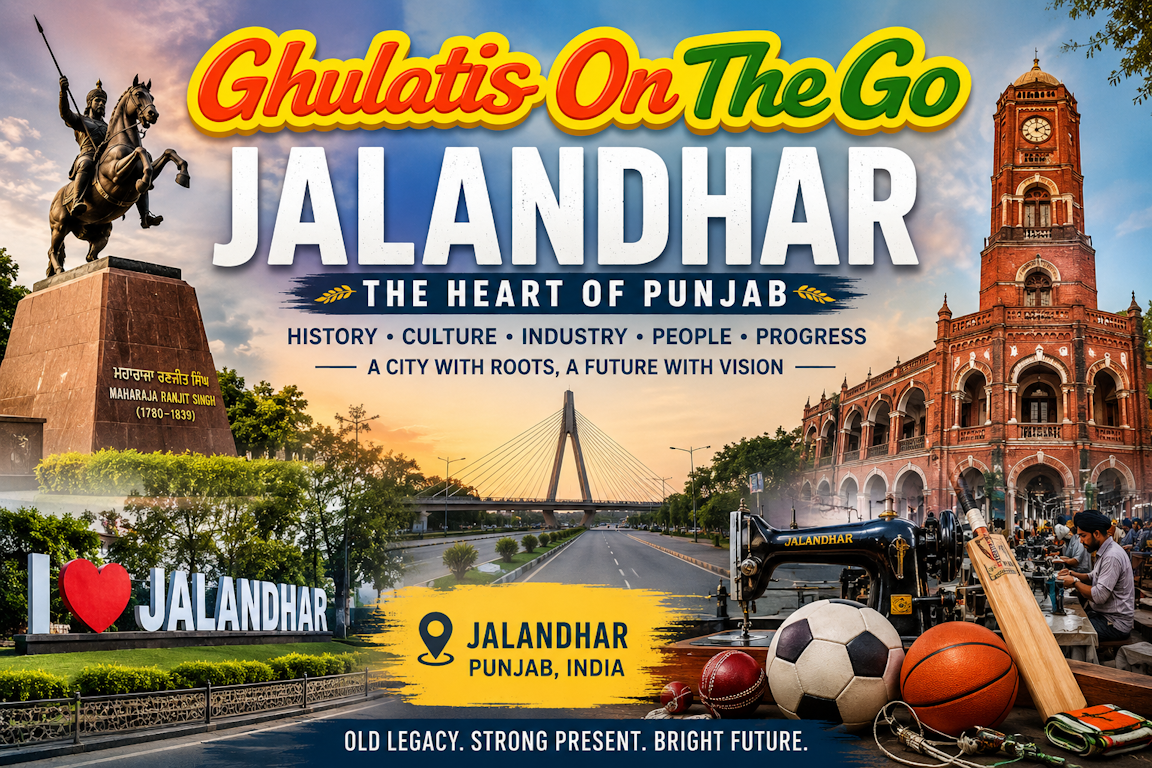
Jalandhar is a city that carries history in its streets, stories in its neighborhoods, and pride in its people. Located in the Doaba region of Punjab between the Beas and Sutlej rivers, Jalandhar is one of the oldest continuously inhabited cities in India. While many Indian cities are known for monuments or tourism, Jalandhar is known for something much deeper. It is known for resilience, identity, hard work, and an emotional connection that Punjabis around the world still carry with them generations later.
The origins of Jalandhar are surrounded by mythology and legend. According to local historical traditions and references in ancient Hindu texts, the city is believed to be connected to the demon king Jalandhar, who is mentioned in the Puranas and other ancient literature. Another tradition links the region to Lav, the son of Lord Rama. Some historians also believe the name may have evolved from the words meaning “land within waters” because the region lies between important rivers.
Over centuries, Jalandhar witnessed the rise and fall of multiple empires. Ancient rulers, Rajput dynasties, the Delhi Sultanate, the Mughals, and later the Sikh Empire all left their mark on the region. During the Mughal era, Jalandhar became an important administrative and military center because of its strategic location in Punjab. Trade routes passed through the city, bringing merchants, travelers, craftsmen, and cultural influences from different regions.
Like much of Punjab, Jalandhar’s identity changed dramatically during the Partition of India in 1947. Before Partition, the city had a large Muslim population alongside Hindu and Sikh communities. Following Partition, many Muslim families migrated to Pakistan, while Hindu and Sikh refugees arriving from cities like Lahore and other parts of West Punjab settled in Jalandhar. The trauma of Partition deeply affected the city, but it also shaped the entrepreneurial spirit that later became one of Jalandhar’s defining characteristics.
Families who arrived with very little slowly rebuilt their lives through business, manufacturing, trade, and education. Over time, Jalandhar transformed into one of Punjab’s most important industrial and commercial cities. The city became especially famous for sports goods manufacturing, and today many international sporting products still originate from factories and workshops in and around Jalandhar. Cricket bats, footballs, hockey equipment, and athletic gear produced here have reached markets across the world.
Jalandhar also developed strong industries in leather, hand tools, surgical instruments, textiles, rubber goods, and manufacturing. Its business culture became known for small and medium family owned enterprises built through generations of hard work. Unlike some cities that depend heavily on government or corporate sectors, Jalandhar’s economy has largely been driven by local entrepreneurship and community business networks.
Today, Jalandhar remains one of Punjab’s largest and most influential cities. According to the 2011 Census of India, Jalandhar city had a population of approximately 868,929 people, while the larger district population exceeded 2.19 million. Current metro area estimates place the urban population at over 1.1 million residents, although official updated census numbers are still awaited due to delays in the national census process.
The city has a relatively high literacy rate compared to many parts of India. Census figures show literacy levels above 86 percent within the urban population, with male literacy slightly higher than female literacy. Punjabi remains the dominant language spoken across the city and district, though Hindi and English are widely understood, particularly among younger generations and business communities.
Religion in Jalandhar reflects Punjab’s diverse social fabric. Hinduism forms the majority religion within the city, while Sikhism represents a significant and deeply influential part of the population. Smaller communities of Christians, Jains, and others also contribute to the city’s identity. The district also has one of the highest Scheduled Caste population percentages in Punjab, representing nearly 39 percent of the district population according to Census 2011 data.
One of the most remarkable aspects of Jalandhar is its global Punjabi connection. Large numbers of families from Jalandhar and surrounding Doaba villages migrated abroad over the past several decades, particularly to Canada, the United Kingdom, the United States, Italy, and Australia. As a result, the city maintains strong international ties. It is common to find homes with relatives overseas, businesses connected to foreign markets, and young people balancing local Punjabi culture with global aspirations.
This overseas Punjabi influence is visible throughout the city. Restaurants, schools, real estate developments, fashion trends, and even local conversations often reflect the close connection between Jalandhar and the Punjabi diaspora. The city has become a place where traditional Punjabi values and global exposure comfortably coexist.
Jalandhar is also deeply associated with Punjabi music and entertainment culture. Many famous Punjabi singers, actors, lyricists, and music producers have roots connected to the city or surrounding Doaba region. Over the last two decades, Punjabi music videos, independent music labels, and digital media culture have helped make Jalandhar one of the cultural centers of modern Punjabi entertainment.
Education has also become an increasingly important part of the city’s growth. Institutions such as Lovely Professional University near Jalandhar have attracted students from across India and abroad, contributing to the city’s growing educational identity. Schools, coaching centers, technical institutes, and colleges continue expanding as more families prioritize education and professional careers.
Despite modernization, Jalandhar still retains the warmth and rhythm of a traditional Punjabi city. Markets remain crowded and energetic. Local sweet shops and dhabas continue serving generations old recipes. Religious processions, weddings, festivals, and community gatherings remain deeply woven into everyday life. The city’s food culture reflects the rich flavors Punjab is known for, with butter laden parathas, chole bhature, tandoori dishes, sweets, and street food remaining central to the local lifestyle.
Like many growing Indian cities, Jalandhar also faces urban challenges. Traffic congestion, infrastructure pressure, pollution, waste management, and rapid urban expansion continue to test the city’s planning systems. Young professionals sometimes leave for opportunities in Chandigarh, Delhi, or abroad, while traditional industries face increasing competition from automation and international manufacturing markets.
At the same time, the future of Jalandhar continues to hold enormous potential. Infrastructure improvements, highway expansion, digital business growth, educational development, and industrial modernization are gradually reshaping the city. Improved connectivity to other major cities in Punjab and northern India is helping strengthen trade and commerce. New residential developments, malls, healthcare facilities, and commercial projects continue to expand across the region.
The city’s future may ultimately depend on how successfully it balances modernization with preservation of its cultural identity. Jalandhar’s greatest strength has always been its people. The entrepreneurial mindset, strong family networks, deep community bonds, and global Punjabi connections continue to give the city a unique resilience that few places possess.
For many Punjabis living abroad, Jalandhar is more than just a city. It represents memories, family roots, language, music, food, and identity. Even generations later, many families still maintain emotional ties to the city and surrounding villages. Weddings, religious events, holidays, and family gatherings continue bringing people back home year after year.
Jalandhar may not always appear on international tourist lists the way Delhi, Jaipur, or Amritsar do, but its story is equally important in understanding Punjab and modern India. It is a city shaped by migration, survival, business, faith, music, and ambition. It is a city where the past still quietly lives alongside the future.
Whether someone experiences Jalandhar through its crowded bazaars, industrial workshops, Punjabi music culture, old neighborhoods, or the stories shared by families who built their lives here after Partition, one thing becomes very clear very quickly. Jalandhar is not simply a place on a map. It is an emotion deeply tied to the spirit of Punjab itself.