

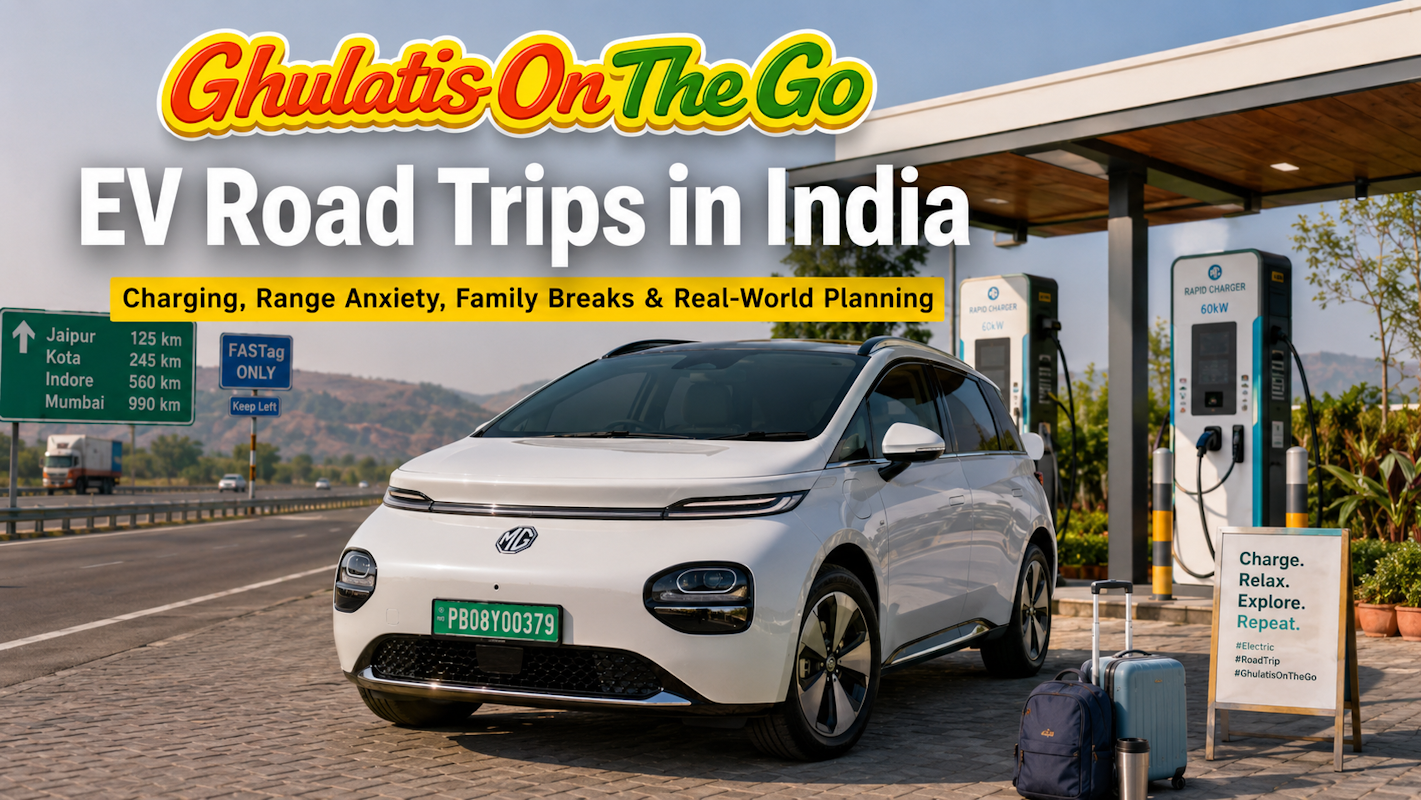
EV road trips in India are becoming more realistic, but they are still different from petrol or diesel road trips. The biggest change is that India’s public charging network is expanding, especially around cities, highways, expressways, hotels, food courts, malls, and major intercity corridors. According to India’s Press Information Bureau, 29,151 electric vehicle charging stations were installed across India during the previous five years, including 8,805 fast charging stations and 20,346 slow charging stations. The same update also noted that ₹2,000 crore had been allocated under the PM E-DRIVE Scheme for public EV charging infrastructure. That growth matters because it shows that EV infrastructure is no longer limited to a few large cities, but drivers still need to remember that network growth does not automatically mean every charger is working, available, compatible, or easy to access at the exact time they arrive.
For families, the honest answer is this: long EV road trips in India are possible, but they require a different mindset. A petrol or diesel road trip allows you to assume that fuel will be available almost anywhere on a major highway. An EV road trip requires more planning because charging takes longer, apps may show different station information, some chargers may be occupied, and some routes still have large gaps. Ministry of Power guidelines call for at least one public charging station every 25 km on both sides of highways and at least one fast charging station every 100 km for long-range or heavy-duty EVs, but those are infrastructure guidelines, not a guarantee that every route will feel equally convenient today. A smart EV traveler plans with patience, checks recent app reviews, and keeps backup chargers ready before leaving home.
Some corridors are more practical than others because they have better charger density, stronger operator presence, and more family-friendly highway stops. Delhi to Jaipur is one example where TATA.ev and Statiq commissioned MegaChargers at Gurugram, Kaprivas, Hamzapur, and Shahpura. Mumbai to Pune is another important corridor, with ChargeZone and Tata.ev launching a 720 kW Mega Charging Hub at Khalapur on the Mumbai–Pune Expressway that can charge up to 10 EVs at the same time. Bengaluru to Chennai is also becoming more EV-friendly, with ChargeZone reported to have deployed fast-charging stations along Bengaluru–Chennai and several other key highway routes. These examples show why some EV road trips now feel practical, but they also show why route choice matters. A route with multiple known charging stops is very different from a rural or hilly route with one unreliable charger and no strong backup.
The biggest day-to-day challenge is India’s multi-app charging ecosystem. There is no single app that covers every public charger perfectly. Drivers may need to use Tata Power EZ Charge, Statiq, ChargeZone, Jio-bp pulse, PlugShare, and sometimes the car manufacturer’s own charging locator. Tata Power EZ Charge says its app can locate charging stations, book slots, save favorite chargers, and plan charging stops. Statiq reports more than 7,000 chargers across 63+ Indian cities. PlugShare is useful because drivers can contribute station reviews and photos, filter by plug type and charging speed, and check what other EV owners recently experienced at a location. The practical lesson is simple: before a long trip, download the apps, create accounts, add payment methods, test logins, and save chargers before you are standing at a highway station with low battery and poor mobile signal.
Understanding charger type is also important. AC chargers are useful for home charging, office charging, hotels, overnight stops, and slow top-ups. They are usually not the best choice when a family is waiting on a highway during the day. DC fast chargers are designed for faster travel stops and are the most useful option on national highways and busy expressways. The U.S. Department of Transportation explains that DC fast charging can charge many battery electric vehicles to 80% in about 20 minutes to one hour, depending on the charger, vehicle, and conditions. That range is important because it means a charging stop may fit naturally with lunch, tea, restrooms, and stretching, but it also means EV travel is not the same as a five-minute fuel stop.
Range anxiety is not just fear; it is a planning problem. Certified range numbers are measured under controlled conditions, while real-world range changes with speed, temperature, elevation, traffic, tire pressure, passengers, luggage, driving style, and air-conditioning use. The U.S. Department of Energy notes that ambient temperature affects range and energy consumption, partly because heating or cooling the cabin adds load to the battery. In Indian summers, constant air conditioning can matter because the vehicle may be carrying a full family, luggage, and passengers who need a comfortable cabin. Highway speed matters too. A calm, steady driving style usually gives more predictable range than repeated hard acceleration and braking.
The 20 to 80 rule is one of the most useful habits for EV road trips. The idea is to avoid arriving at chargers with a dangerously low battery and to avoid wasting too much time charging from 80% to 100% unless you truly need the extra range. Fast charging is usually most time-efficient in the lower and middle part of the battery. Charging often slows near the top of the battery because the vehicle’s battery management system protects the battery as it fills. This is why charging from 20% to 80% and continuing to the next planned stop can often be faster than waiting for 100% at every station. For families, this also creates a more natural rhythm: drive for a while, stop for food and restrooms, charge enough to continue safely, and move on.
Terrain can change the entire trip. Driving on a flat expressway is different from climbing ghats, heading toward a hill station, or exiting a major highway onto smaller state roads. Climbing elevation requires more energy because the car is moving uphill against gravity. On the way down, regenerative braking can recover some energy that would otherwise be lost as heat during braking, but it should not be treated as a full replacement for the energy used during the climb. Regenerative braking is helpful, especially on downhill stretches and stop-and-go driving, but a safe driver still plans with extra battery buffer before entering hilly or rural areas.
Family comfort is where EV road trip planning becomes very practical. A 45-minute charging stop can be easy if it happens at a clean food court, hotel, restaurant, dhaba, or highway rest stop with toilets, shade, seating, and safe parking. The same 45 minutes can feel frustrating if the charger is isolated, the restroom is poor, there is no place to sit, or elderly passengers have to wait in heat. For family travel, the best charger is not always the fastest charger on the map. Sometimes the better stop is the charger with clean amenities, visible security, food options, and a safe place for children and elderly family members to rest.
Overnight charging can make the next day much easier, but it should be verified before arrival. If a hotel claims to offer EV charging, call and ask specific questions. Ask whether the charger is active, whether it works with your car, whether it is AC or DC, whether staff know how to activate it, whether it is blocked by parked vehicles, and whether it is available overnight. Also ask whether guests recently used it successfully. The words “EV charging available” are helpful, but they are not enough for a family road trip where the next morning’s departure depends on that charge.
A good EV plan always includes a backup charger. Before leaving for any charging stop, identify another charger that your vehicle can reach comfortably if the first one is down, full, blocked, or incompatible. This is especially important during long weekends, school holidays, festivals, wedding seasons, and peak travel days. Charger queues are not only an infrastructure problem; they are also a timing problem. If ten EVs reach the same highway charger around lunch, even a working charger can become a delay. Starting earlier, charging before the battery is too low, and avoiding the most obvious peak-hour stops can make the trip smoother.
Public charging etiquette is becoming more important as EV adoption grows. If a petrol or diesel vehicle is parked in a dedicated EV charging slot, many EV owners call that ICE-ing. The best response is to stay calm, ask the location staff for help, and report the issue through the charging app if the app allows it. EV owners also have responsibilities. If other drivers are waiting, avoid occupying a DC fast charger after your car reaches around 80% unless you truly need that extra charge to reach the next stop. Once charging is complete, move the car promptly. A public charger is shared infrastructure, not a parking space.
Hardware planning matters more in India than many people expect. A portable 15A charger can be useful as an emergency backup at a home, hotel, farmhouse, or guest house, but it should not be treated as a replacement for planned public charging. Portable charging from a regular socket is slow, and the electrical connection must be safe. Proper earthing is especially important. Some portable chargers have built-in safety checks and may refuse to charge if they do not detect proper earthing. If a socket has earthing issues, the safe answer is to use a properly earthed socket or ask for a qualified electrician, not to bypass the safety system.
Extension cables require caution. A light household extension cord is not suitable for long-duration EV charging. If an emergency extension cable is carried, it should be heavy-duty, properly rated, fully unwound during use, and kept away from water, heat, and vehicle movement. Even then, it should be used only when the electrical setup is safe. EV charging is a continuous electrical load, and weak plugs, poor wiring, loose sockets, and bad earthing can create risk. When in doubt, do not charge from an unknown socket just because it fits.
Extreme heat can also affect charging behavior. Charging speed depends on many factors, including the charger, vehicle, battery temperature, air temperature, and state of charge. In very hot conditions, the vehicle or charger may reduce charging speed to protect the battery and equipment. This is often called thermal throttling. It can feel frustrating when a charger is rated for high power but the car accepts less power than expected. The important thing is to understand that the number printed on the charger is the maximum possible output, not a promise that every car will receive that speed at every temperature and battery level.
The financial side is one of the strongest reasons many families become interested in EV road trips. The actual savings depend on your car’s efficiency, the charging rate, the route, and the price of petrol or diesel. A simple example makes the comparison easier. If a mid-sized EV SUV uses 15 kWh per 100 km on the highway and a DC fast charger costs ₹20 per kWh, the electricity cost is ₹300 per 100 km, or ₹3 per km. For comparison, Reuters reported that diesel in New Delhi was ₹91.58 per litre after a May 2026 price increase. At that diesel price, a diesel SUV giving 16 km per litre would cost about ₹5.72 per km, while one giving 12 km per litre would cost about ₹7.63 per km. This is only an example, not a universal rule, because fuel prices, charging rates, and vehicle efficiency change by city, route, driving style, and season.
EV savings are usually strongest when the vehicle is charged at home, but road trips often rely more on public DC fast charging, which costs more than home electricity. That means the EV still may save money compared with petrol or diesel, but the savings are not always as dramatic as daily city driving. For a fair comparison, families should calculate using their own vehicle’s highway efficiency, their actual charging cost, and the fuel economy of the petrol or diesel vehicle they would otherwise use.
The best EV road trip checklist is not complicated, but it must be done before departure. Charge the vehicle fully before leaving home if possible. Check tire pressure because underinflated tires can reduce efficiency. Download and log in to multiple charging apps. Add payment methods. Save primary and backup chargers. Check recent PlugShare or app reviews. Carry a portable charger only as backup. Keep water, snacks, medicines, power banks, and offline maps ready. Share the route with family members. Plan stops around people, not only around battery percentage. Children, elderly passengers, and drivers all need breaks before they become uncomfortable.
The safest route plan is flexible. Do not plan a long EV journey with every stop depending on perfect charger performance. Real-world travel includes traffic, rain, heat, queues, detours, closed service roads, blocked chargers, payment failures, app login problems, and mobile network issues. A good EV plan leaves margin. A great EV plan leaves margin twice: once for the battery and once for the family. That means reaching chargers earlier than the minimum, keeping extra time in the schedule, and accepting that some journeys will be smoother if you stop before the car absolutely needs to stop.
The myth that EV road trips in India are impossible is outdated. The better truth is that EV road trips are possible on many routes, especially stronger corridors, but they reward preparation more than impulse. India’s charging network is improving, and major operators are expanding coverage, but the driver still has to verify charger status, plan around real-world range, respect the battery’s charging curve, and keep family comfort at the center of the trip. EV travel is not only about reaching the destination; it is about learning a new travel rhythm. Drive calmly, charge intelligently, take meaningful breaks, respect other EV users, and always keep a backup plan. With that mindset, range anxiety becomes less of a fear and more of a planning habit.