
Introduction
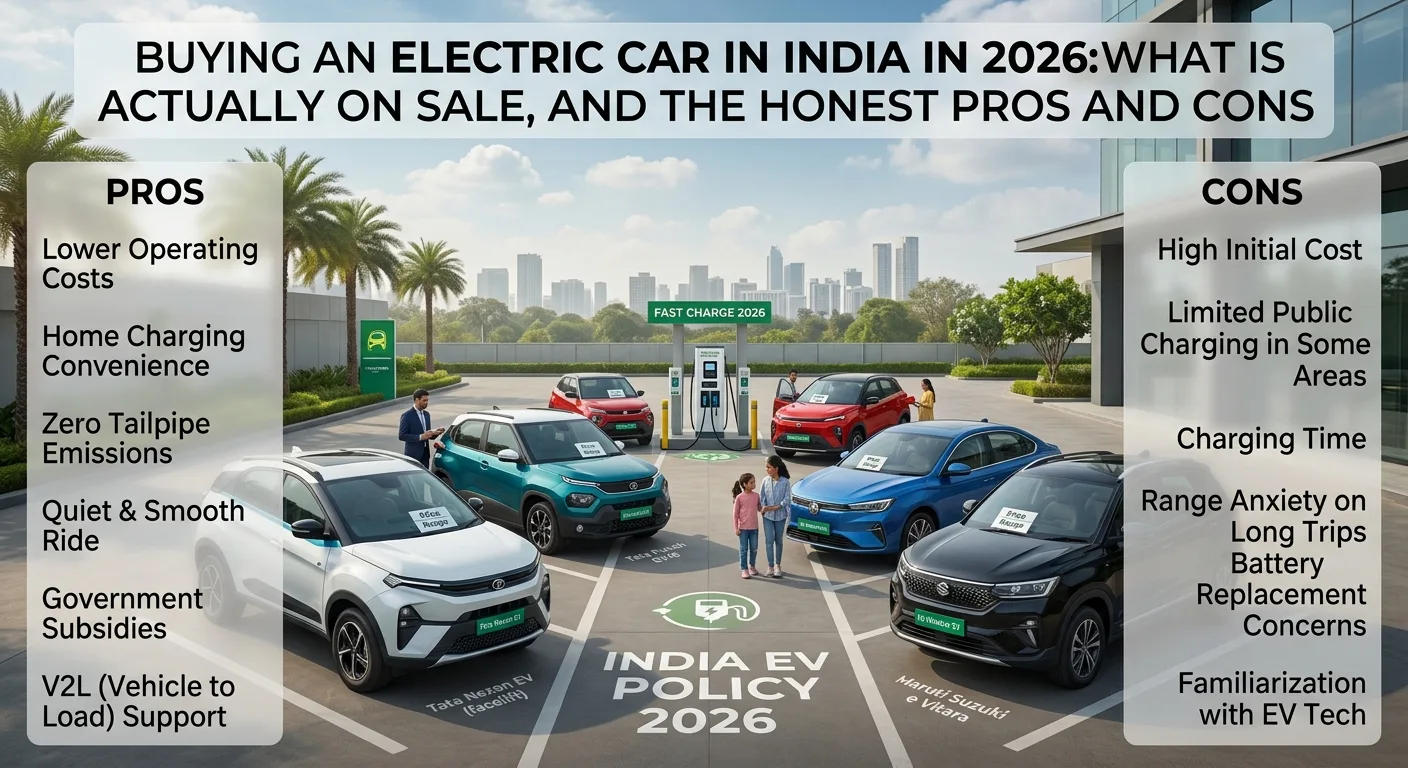
A few years ago, "electric car" in India mostly meant one or two models and a long wait. In November 2026 the picture is very different. Autocar India's electric car listing currently shows 97 electric cars, spanning hatchbacks, SUVs, sedans and MPVs, and almost every major carmaker has at least one on sale or on the way. Tata, Mahindra, MG, Hyundai, Maruti Suzuki, Kia, BYD and VinFast all sell electric cars to Indian buyers today.
That is good news, but a long list is not the same as a good buying decision. Claimed range figures are tested in controlled conditions, public charging is uneven, and some of the cheapest prices come with conditions attached. This guide sticks to what is documented: prices and claimed specifications as listed by Indian automotive publications in mid-November 2026, real-world range figures where independent testers have published them, and the pros and cons reviewers actually report. Where a number varies between sources, we say so. All prices are ex-showroom and change often, so confirm with a dealer before you decide.
Why the numbers look better for EVs in India right now
The biggest advantage electric cars have in India is tax. Since the GST reform of September 2025, electric cars are taxed at 5% GST nationwide, while smaller petrol and diesel cars sit at 18% and larger ones such as mid-size sedans and SUVs attract 40%, according to Autocar India. Its worked example: a car with a pre-tax price of ₹14 lakh becomes ₹14.70 lakh ex-showroom as an EV, but ₹19.60 lakh as a petrol or diesel SUV at 40% GST.
State policy adds a second layer. Autocar India notes that some states, including Delhi and Haryana, have waived RTO charges on electric cars. But this is not uniform. Karnataka ended its blanket road tax exemption from 1 April 2026 and now charges a lifetime levy of 5% for EVs up to ₹10 lakh, 8% for ₹10–25 lakh and 10% above ₹25 lakh, as reported by Angel One. Anyone comparing on-road prices should check their own state's rules.
There is also a caution. The Centre for Social and Economic Progress (CSEP), an Indian policy think tank, found that privately owned electric cars in India continue to depend on the existing tax incentives, including the 5% GST rate and the motor vehicle tax exemption, until at least 2030. Cheap EV pricing today is, in part, a policy decision that could change.
Entry level: Tiago EV, Punch EV and the small city cars
The Tata Tiago EV is the cheapest electric car in India, priced from ₹6.99 lakh to ₹10.09 lakh with a claimed range of 226 to 285 km, per Autocar India. MeraEV's buyer guide puts its usable real-world range at around 200 km, which is a useful reminder that the claimed figure is a ceiling, not a promise. Autocar India lists the Tiago EV, the MG Comet and the Tata Punch EV as the models that suit daily commuting.
Pros: lowest purchase price among electric cars; compact and easy in city traffic; large Tata service network.
Cons: limited range for regular highway trips; the headline price is for the base variant.
The Tata Punch EV costs more, at ₹9.79 lakh to ₹12.99 lakh, but Autocar India lists a claimed range of 365 to 468 km, a big step up in range for a modest step up in price. MeraEV's comparison shows the Punch EV facelift sitting roughly ₹3 lakh below the Nexon EV with a range figure close to it (468 km versus 489 km claimed), which makes it a sensible choice for buyers who want an SUV stance on a budget.
Pros: SUV-style body at a hatchback price; a wide range spread across its variants.
Cons: as with every EV, the longest-range version costs noticeably more than the base car.
Family SUVs and crossovers: where most buyers are shopping
Tata Nexon EV and Curvv EV
The Tata Nexon EV starts at ₹12.49 lakh with claimed range of 275 to 489 km, depending on the battery. Autocar India's listing shows a 5-star safety rating, which matters because it also points out that crash-test ratings are missing for a lot of EVs on sale in India. The Tata Curvv EV, a coupe-style SUV, starts at ₹16.99 lakh with a 55 kWh battery and a claimed ARAI range of 502 km. When Autocar India tested it, the real-world figure was 365 km, about 73% of the claim.
Pros: wide choice of battery sizes; 5-star safety rating listed for the Nexon; Tata's EV service network.
Cons: the Curvv's tested range falls well short of its claim; both sit in a crowded segment with rivals offering more range at similar prices.
MG Windsor
The MG Windsor is an unusual shape, part MPV and part crossover, and it has sold well. Onmanorama reported that it sold over 46,735 units in 2025. Autocar India lists it from ₹14.85 lakh. The original 38 kWh version has a claimed range of 332 km, and in Autocar India's road test it delivered an extrapolated real-world range of 308 km, which is unusually close to the claim. A larger 52.9 kWh version claims 449 km.
Reviewers praise the space. Autocar India highlights rear seats that are well padded and wide enough for three abreast, with a reclining backrest, and the car has 604 litres of boot space. On the downside, Team-BHP notes that the MPV styling may not appeal to everyone, that the headlight placement makes them prone to damage, and that the air conditioning takes time to cool the large glass-heavy cabin.
Pros: generous rear-seat space; large boot; real-world range close to the claim in Autocar India's test.
Cons: polarising styling; slow cabin cooling; long highway trips need planning on the smaller battery.
Maruti Suzuki e Vitara
Maruti Suzuki began deliveries of the e Vitara, its first electric car, on 17 February 2026. Autocar India lists it from ₹16.19 lakh to ₹19.99 lakh with a claimed range of 440 to 543 km. There are two battery packs: 49 kWh (144 hp, 440 km ARAI) and 61 kWh (174 hp, 543 km ARAI), both front-wheel drive.
The ownership package is the real story. Maruti offers an 8-year or 1,60,000 km warranty on the battery and a 3-year warranty on the car, plus an assured buyback of 60% of value on a 3-year/45,000 km plan and 50% on a 4-year/60,000 km plan. A 7.4 kW home charger with free installation is included, along with free charging at Maruti dealerships for 1,000 units or one year, whichever comes first. The car also earned a 5-star Bharat NCAP rating. At launch, Maruti introduced a battery-as-a-service price of ₹10.99 lakh plus ₹3.99 per km, though that was an introductory offer valid until 31 March 2026.
Pros: 5-star Bharat NCAP rating; strong warranty and buyback terms; Maruti's wide dealer network.
Cons: DC fast charging is rated up to 70 kW (10–80% in about 45 minutes); front-wheel drive only; it is Maruti's first EV, so long-term ownership data is limited.
Hyundai Creta Electric
The Hyundai Creta Electric starts at ₹18.02 lakh and, per Autocar India, offers claimed ARAI range of 390 km (42 kWh) and 473 km (51.4 kWh). Autocar India's tests of the larger battery returned about 406 to 426 km in mixed driving, which is close to the claim for the larger pack. Charging from 10 to 80% takes 58 minutes with a 50 kW DC charger. The battery is covered for eight years or 1.6 lakh km.
Autocar India scores it 9 out of 10. Its long-term test car had covered 9,065 km by June 2026 with no faults and no maintenance cost, returning 7.9 km/kWh. Its listed complaints are modest: no wireless Android Auto or Apple CarPlay, slightly knees-up rear seating, and steering that is heavier than the standard Creta.
Pros: tested range close to the claim; feature-rich; spacious cabin and practical boot; strong battery warranty.
Cons: no wireless smartphone mirroring; rear seating posture; front-wheel drive only.
Kia Syros EV
Autocar India lists the Kia Syros EV from ₹13.50 lakh, with 42 kWh and 51.4 kWh options and claimed ranges of 443 km and 526 km, and recommends it as a value-for-money five-seater with a spacious cabin.
Bigger and bolder: Mahindra BE 6, XEV 9e and Tata Harrier EV
Mahindra BE 6 and XEV 9e
Mahindra's born-electric SUVs were launched in November 2024. Autocar India's current listing shows the BE 6 Sporteq at ₹20.20 lakh to ₹27.70 lakh with a claimed range of 548 to 683 km. ZigWheels lists the XEV 9e from ₹21.90 lakh with claimed range of 522 to 656 km. CarTrade lists the three-row Mahindra XEV 9S from ₹19.95 lakh, and Autocar India names it among India's 7-seat electric cars.
Autocar India's tested BE 6 delivered about 432 km of real-world range. Its expert review praises the long feature list, strong performance and an outstanding balance of ride and handling, and scores performance and refinement 10 out of 10. It also flags cabin ergonomics and a confusing infotainment system, and scores interior space and comfort only 6 out of 10.
Pros: strong performance; excellent ride and handling balance; very long claimed range; long feature list.
Cons: tight cabin comfort and space for the price; infotainment learning curve; higher prices than most rivals.
Tata Harrier EV
The Harrier EV is priced from ₹21.49 lakh to as much as ₹30.23 lakh, per Autocar India. The 65 kWh version has a claimed range of 538 km and 75 kWh versions claim up to 627 km. In Autocar India's review of the 75 kWh all-wheel-drive version, real-world range came to 436 km at 5.81 km/kWh. It offers a dual-motor, all-wheel-drive option, a lifetime battery warranty, and reviewers report a 5-star crash-test rating. One review from e-vehicleinfo reports 20–80% charging in about 25 minutes on a 120 kW DC charger.
Reviewers also note drawbacks. Carlelo lists reliance on public charging infrastructure for long trips and questions about fit and finish. Spinny's review points out that it is still a premium EV, so buyers chasing pure value may find smaller EVs easier to justify. Autocar India also reported discounts of up to ₹2.75 lakh on the Harrier EV in October 2026, which is worth asking about.
Pros: all-wheel-drive option; long range; fast charging; 5-star safety rating reported; lifetime battery warranty.
Cons: premium price; build quality questions raised by some reviewers; long trips still depend on public chargers.
International brands: BYD and VinFast
BYD currently sells four electric cars in India: the Atto 3, eMAX 7, Seal and Sealion 7. According to 91Wheels, the Atto 3 costs ₹24.99 lakh to ₹33.99 lakh with a 60.48 kWh battery and a claimed 521 km range. The eMAX 7 seven-seat electric MPV costs ₹26.90 lakh to ₹29.90 lakh, the Seal sedan ₹41.00 lakh to ₹53.15 lakh with a claimed 650 km, and the Sealion 7 SUV tops the range at ₹54.90 lakh. These cars are more expensive than the Indian-brand alternatives above, which is the main drawback for most buyers.
VinFast, from Vietnam, assembles the VF6 and VF7 at its Thoothukudi plant in Tamil Nadu, according to Autocar Professional. They launched in September 2025 at ₹16.49 lakh (VF6) and ₹20.89 lakh (VF7). Autocar India now lists the VF6 from ₹18.19 lakh, and ZigWheels lists the VF7 from ₹22.99 lakh. VinFast has also added the VF MPV 7, listed by Carlelo at ₹24.49 lakh with a claimed 517 km range.
Autocar India's experts call the VF7's driving manners and acceleration excellent but warn that VinFast's network is not very widespread and parts availability could cause delays after an accident. That is the central trade-off with any newer brand: good products, smaller support networks.
Battery-as-a-Service: cheaper to buy, not necessarily cheaper to own
MG started the trend. When the Windsor launched in September 2024 at ₹9.99 lakh without the battery, buyers paid an extra ₹3.5 per km to rent the battery. MG later extended the scheme to the Comet and ZS EV. Autocar India reported in May 2025 that 85% of MG buyers still preferred to buy outright, though uptake was growing in Tier III cities.
The attraction is a much lower upfront price: Autocar India's table shows BaaS prices roughly 40% below the outright price for the Comet and Windsor. The catch is that you pay per kilometre for as long as you drive. Cars24 reported that the Windsor's base variant cost ₹3.5 lakh less under BaaS at ₹3.5 per km, which by simple arithmetic means the rental would equal that saving after about 1,00,000 km. A high-mileage driver could end up paying more than the one-time battery cost. Maruti's launch offer of ₹3.99 per km works the same way. Anyone considering this route should calculate their annual distance and compare the total, not just the sticker price.
Charging: better than before, still uneven
India has made real progress. Outlook Business reports that India had 52,718 public EV charging stations as of 31 March 2026 and had crossed 10 million registered EVs of all types by July 2026. IEEFA says the number of public stations has risen more than tenfold since 2022, when there were 5,151. EVFY, citing government data shared in Parliament, says 16,561 of the 52,718 are fast chargers. (Counts vary by source and method; Autocar Professional reports over 29,000 stations in one dataset and 67,657 chargers including battery-swapping points as of 7 August 2026.)
Reliability is the weak spot. IEEFA reports that users still find public chargers that do not work, including some at petrol stations, and its analysts argue that uptime matters as much as the headline number. Autocar India adds that a DC fast charge takes around 40 to 60 minutes, compared with about five minutes at a petrol pump, and that coverage outside major cities is inconsistent. Its advice is blunt: an electric car is ideal if you have access to a home or office charger, and daily charging becomes a hassle without one.
The honest drawbacks, in one place
Drawing from Autocar India's buyer considerations and the reviews above, these are the issues that apply across most electric cars sold in India:
- Real-world range is lower than claimed. Traffic and continuous air-conditioning use cut into it. Tested figures in this guide range from roughly 70% of the claim (Harrier EV 75 kWh AWD: 436 km tested against 622 km claimed) to about 93% (Windsor 38 kWh: 308 km tested against 332 km claimed).
- Crash-test ratings are missing for many models. Autocar India says crash-test results are missing for a lot of EVs on sale.
- Resale values remain weaker. Autocar India believes EVs do not yet hold residual value as well as petrol or CNG cars, though this could improve as the market matures. Buyback programmes such as Maruti's are one response.
- Battery degradation affects range and resale over time, which is why long battery warranties (eight years or 1.6 lakh km from Hyundai and Maruti, lifetime on some Tata models) matter.
- Repair networks are smaller, so repairs can take longer and labour costs may be higher.
- Policy dependence. Tax advantages and state waivers vary by state and can change, as Karnataka showed.
- Adoption is still low. A Maruti Suzuki executive said at the e Vitara launch that EV penetration has stayed around 4–5% over the past two years, and IEEFA says adoption remains in single or low double digits across most segments.
Which one fits which buyer
Autocar India's own guidance maps needs to models. For daily commuting: Tiago EV, MG Comet or Punch EV. For a family car with occasional highway use: Nexon EV, Tigor EV, Citroën eC3X, Syros EV or XUV 3XO EV. For six or seven occupants: Kia Carens Clavis EV, Windsor, BYD eMAX 7 or VinFast VF MPV 7. For long-distance travel with minimal charging stops: Creta Electric, Harrier EV, XEV 9e, Hyundai Ioniq 5. (Autocar India notes that the Carens Clavis EV claims 490 km but returned around 320 to 350 km in its real-world test.)
Our reading of the evidence: if you can charge at home and mostly drive in the city, the Tiago EV or Punch EV make the case for EVs with the least financial risk. If one car must do everything, the Creta Electric's tested range, the e Vitara's warranty and buyback terms, and the Windsor's space each solve a different problem. If you want performance and the longest range, the BE 6, XEV 9e and Harrier EV deliver, at higher prices. And if you do not have a reliable place to charge at night, the evidence suggests waiting.
Final word
The Indian EV market in late 2026 offers real choice, a favourable tax structure and increasingly credible real-world range. It also has uneven charging reliability, uncertain resale values and policy that varies by state. The right EV is the one that matches your daily distance, your access to a home charger and your state's rules. Test drive more than one, ask dealers for current offers, and treat claimed range as a comparison number rather than a guarantee.
Prices and specifications are as listed by the sources below in mid-November 2026 and may change. Always confirm current ex-showroom and on-road prices with an authorised dealer.
Sources and Verification
- Hyundai India (official) – Creta Electric price
- MG Motor India (official) – Windsor EV prices, range and Battery-as-a-Service
- Mahindra (official) – BE 6e and XEV 9e launch press release
- Maruti Suzuki India (official) – e VITARA launch press release, 17 Feb 2026
- VinFast (official) – VF 6 and VF 7 India launch press release
- Tata Motors (official) – Tata.ev
- Press Information Bureau, Government of India – GST rate changes effective 22 September 2025
- All India Radio News – Over 29,000 public EV charging stations (Lok Sabha reply, 10 Feb 2026)
- Free Press Journal (PTI) – India adds over 52,000 public EV charging stations
- EVFY – India crosses 52,700 public EV charging stations
- Business Standard – EV makers relieved as GST Council retains 5% tax on electric cars
- Autocar India – Electric Cars in India (prices, range, buyer considerations)
- Autocar India – Maruti launches e Vitara at Rs 10.99 lakh, battery rental extra
- Outlook Business – Maruti Suzuki prices first electric SUV e Vitara from ₹10.99 lakh
- Autocar India – Tata Curvv EV
- Autocar India – Tata Electric Cars
- Autocar India – Tata Harrier EV full price range
- Autocar India – 8 things to know before buying a Tata Harrier EV
- Autocar India – Tata Harrier EV discounts in October 2026
- Spinny – Tata Harrier EV expert review
Continue exploring
Related guides, articles, and videos
These recommendations are matched to this Blog using its destinations, routes, vehicles, and practical travel topics.
Recommended travel guide
EV Travel in India
Real-world EV travel tips covering range planning, charging stops, hill drives, battery use, and family road-trip expectations.
Open this topic guideRelated reading